Why I built it
Football statistics are everywhere, and most of them come with no way to check them. A record, a points total or a “biggest ever” claim usually arrives without a source, a date or any word on how it was counted.
I wanted the opposite: a place to look at historical league data, compare clubs and seasons, and see exactly where each number came from. It also became a test of the same idea behind my work at Evidence Systems: if a figure matters, you should be able to trace it.
What it holds
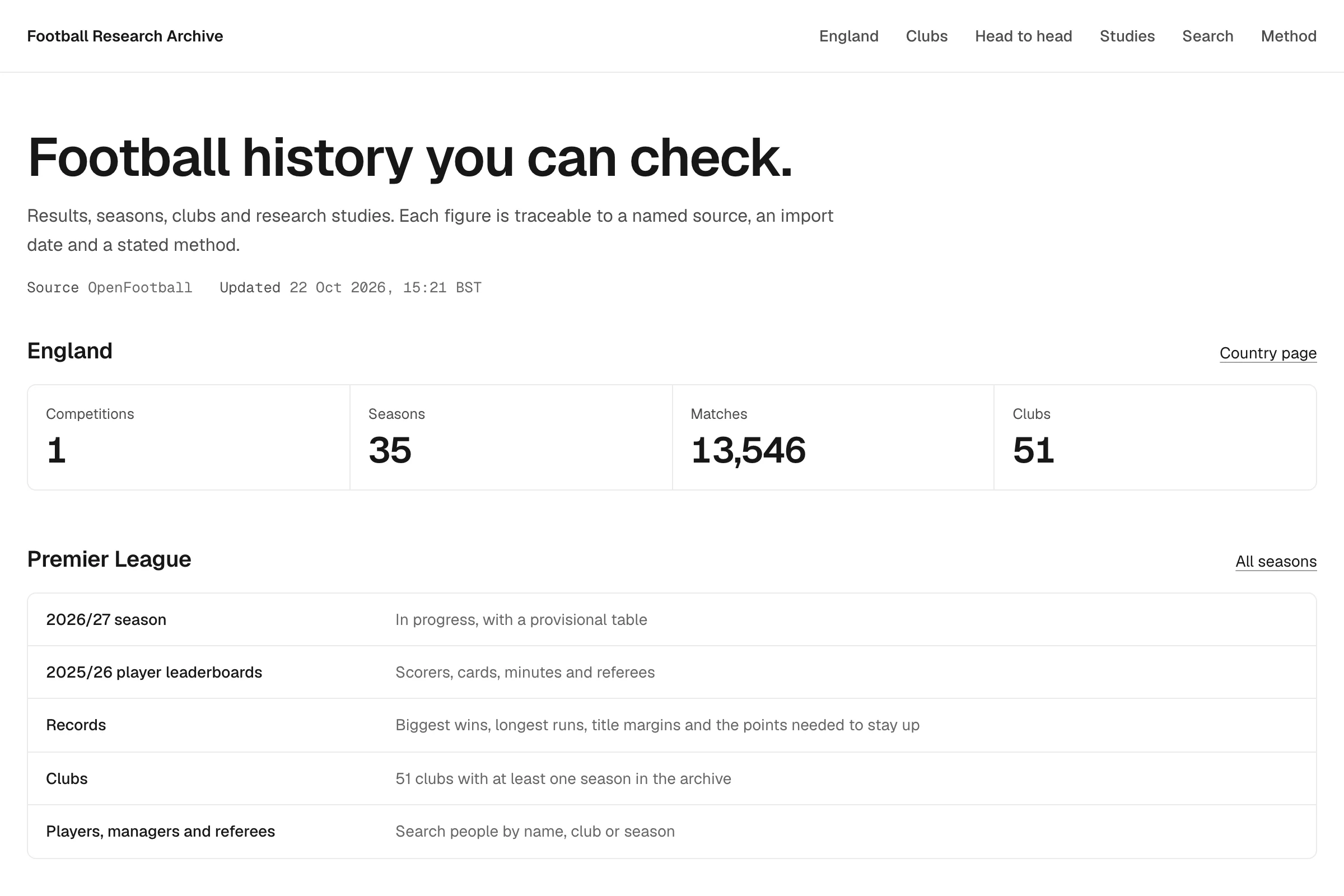
| Competitions (Premier League) | 1 |
|---|---|
| Seasons (1992/93 to 2026/27) | 35 |
| Clubs with at least one season | 51 |
| Matches in completed seasons (1992/93 to 2025/26) | 13,166 |
The current season, 2026/27, is in progress and has a provisional table. The 34 completed seasons, 1992/93 to 2025/26, each have a published final table, and the records are calculated from those.
The archive is built around five things:
- Seasons and tables. Every season's results and league table, with the current season updated as it is played.
- Records. Biggest wins, highest-scoring matches, longest winning runs, most and fewest points, title margins and the fewest points that kept a club up, season by season.
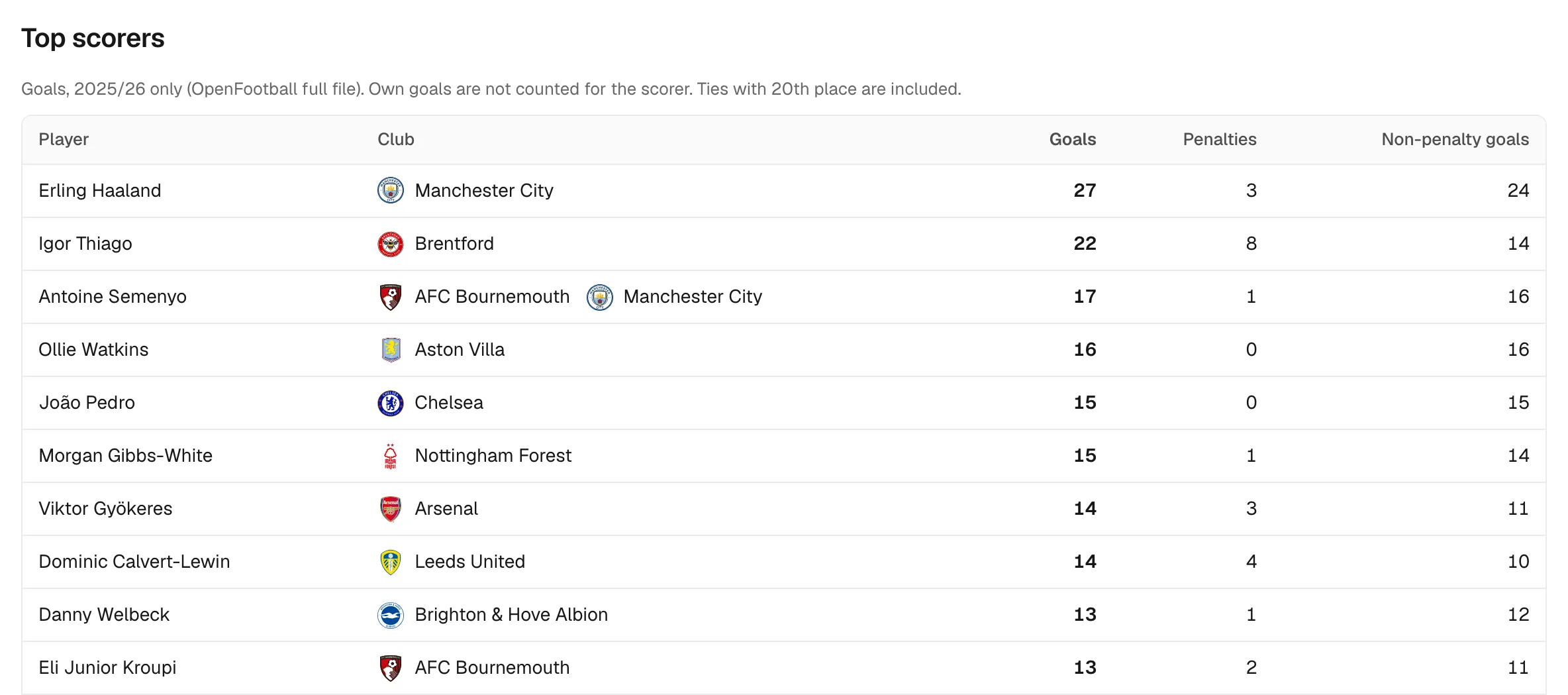
- Player leaderboards. For 2025/26: scorers (penalties and non-penalty goals shown apart), cards, minutes and appearances, and referees.
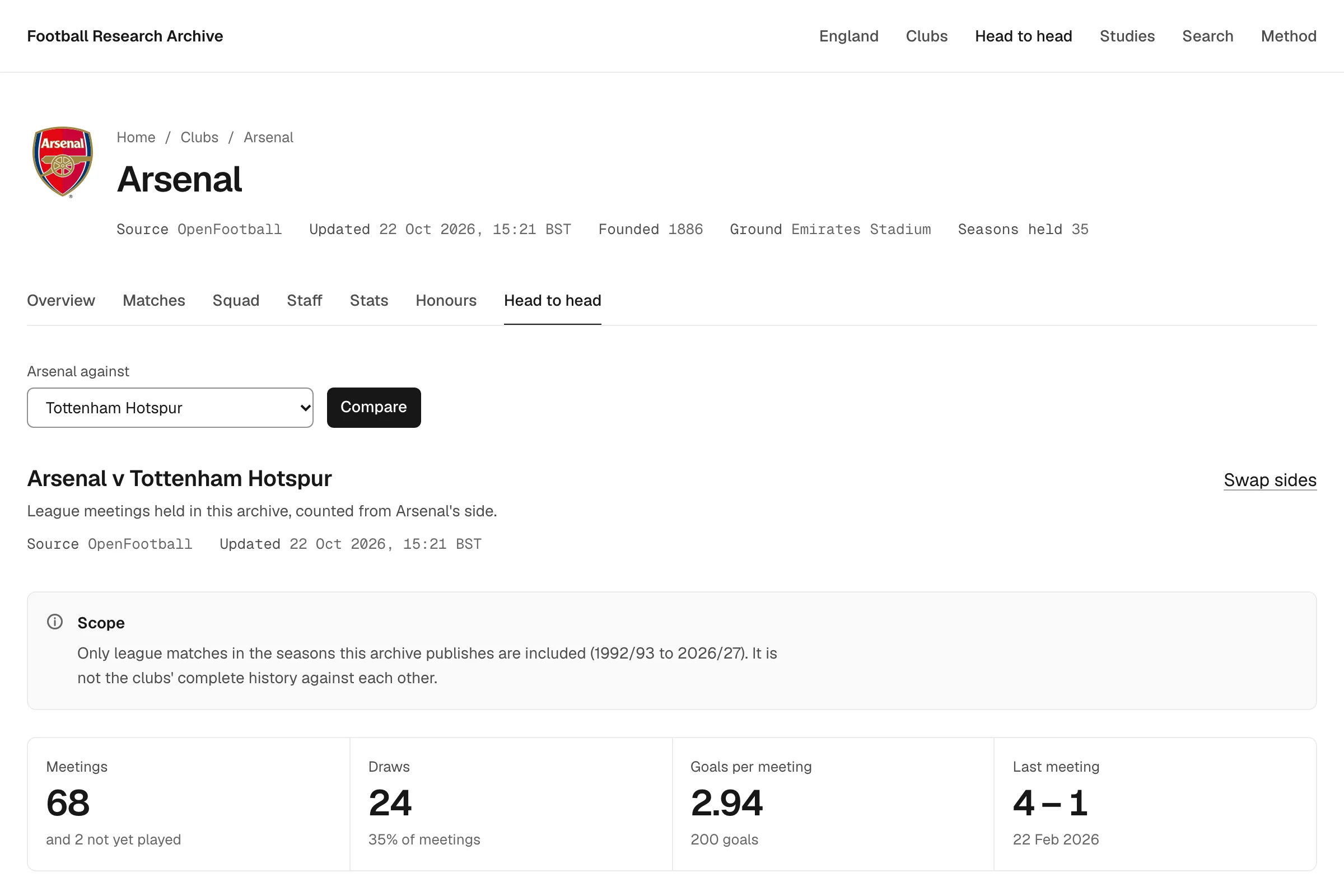
- Head to head. Pick any two clubs and see every league meeting in the seasons the archive holds.
- Studies. Short pieces of research built on the archive's data. Each one states its question, method, data cutoff and limits, with the tables to check its arithmetic.
A few things the records show
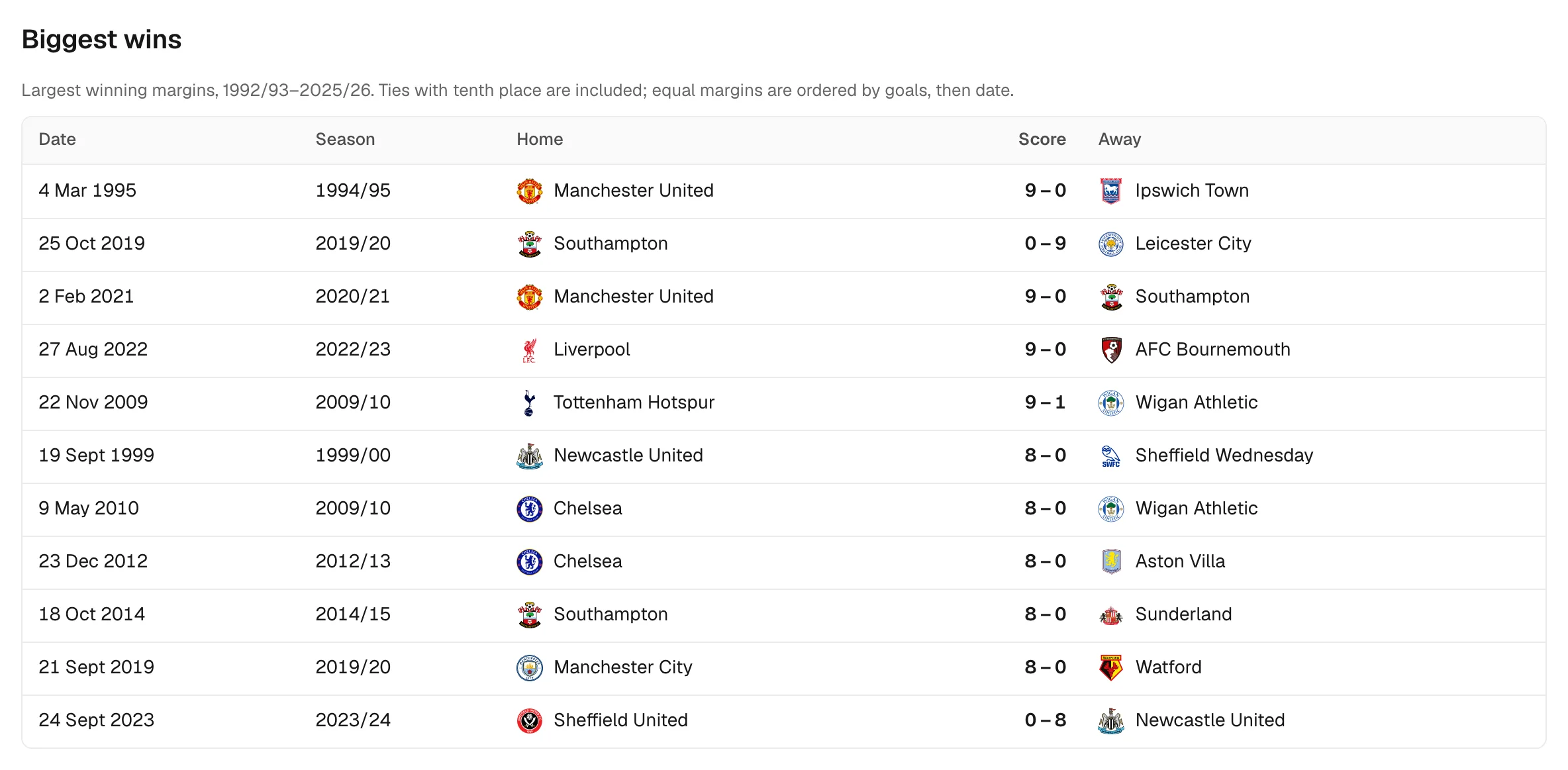
These are the archive's own calculations from cited results, not official league records.
- The biggest winning margin is nine goals, and it has happened more than once: Manchester United 9–0 Ipswich Town in March 1995, Southampton 0–9 Leicester City in October 2019 and Manchester United 9–0 Southampton in February 2021, among others.
- The longest winning run is 18 matches, shared by Manchester City (August to December 2017) and Liverpool (October 2019 to February 2020).
- The most points in a season is 100, by Manchester City in 2017/18. The fewest is 11, by Derby County in 2007/08.
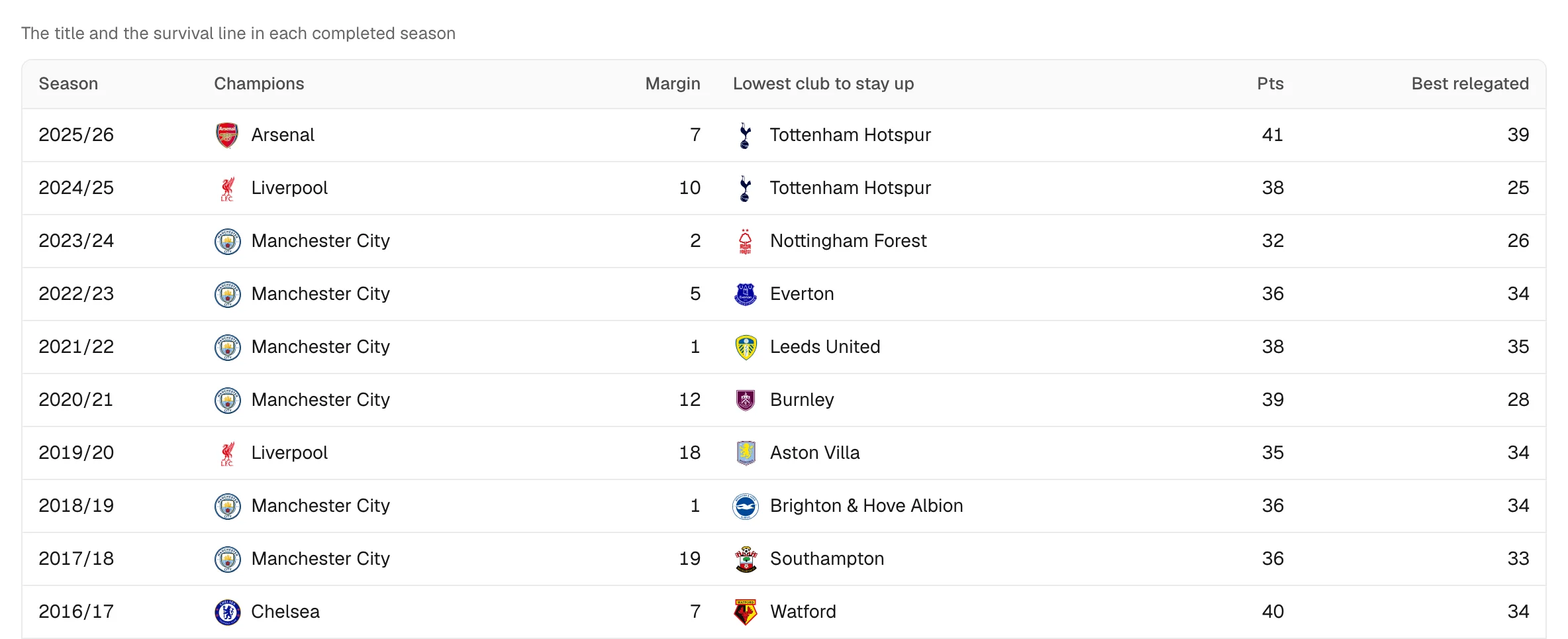
- In 2025/26, Arsenal won the title by 7 points, and Tottenham Hotspur were the lowest club to stay up, on 41 points.
How it works
- Named sources only. The data comes from OpenFootball, football-data.co.uk, the Premier League, Wikidata and English Wikipedia. Each source's licence is recorded and reviewed, and a source is shown publicly only when its licence allows public use of derived data. No scraping, no undocumented APIs.
- Checked on the way in. Every import is fingerprinted and checked for bad dates, scores, duplicates and impossible values. Rows that fail are held back. Running an import again changes nothing.
- Clubs matched carefully. A club is matched only on a known identifier or an exact name in the right country. Anything uncertain goes to an editor.
- Tables calculated, then checked. League tables are calculated from results (three points for a win, one for a draw, then goal difference and goals scored) and published only after a check for points deductions, each recorded with its official source.
- Corrections kept. When a source corrects a result, the change is stored as a revision and noted on the match page.
- Facts kept apart from opinion. Documented facts, third-party claims and editorial interpretation are labelled separately.
What it doesn't claim
A missing statistic means the archive doesn't hold it, not that it was zero. Player data covers 2025/26 only; earlier seasons hold results, so there are no all-time player tables yet. Studies describe patterns in a stated period and don't claim causes unless the method supports it. It is not a live-score or betting service. The method page, sources and licences and corrections policy set out the detail.
Explore it
- Start on the home page for the headline figures and latest studies.
- Browse the Premier League, season by season.
- Look at the records.
- Compare two clubs.
- Read the studies.
If you spot an error, the archive's corrections page is the quickest way to report it.
How the method works in detail, and what it is for beyond football, is in the Evidence Systems case study.