

Why we built it
The Truth and Reconciliation Commission was set up in 1995 to deal with the gross human rights violations of the apartheid years. It heard victims and their families, heard people who applied for amnesty, held special hearings on business, the media, the faith community and others, and set out its work in a Final Report. It was a defining moment in South Africa's history, and its approach is still studied around the world as a way of moving a country past conflict.
The record it left is public, through the SABC and the South African History Archive, but it is hard to work with. Thousands of transcripts and decisions sit as separate pages, with no easy way to see where the Commission went, how many hearings it held in a town, or what happened to a single amnesty application from first hearing to final decision.
So we treated it as a test: what does it take to turn an archive built decades ago into something a researcher, a student or anyone curious can explore in an afternoon?
What the archive holds
Every record comes from the SABC / SAHA Truth Commission Special Report. We collected all 6,869 documents and kept each one with its original link, so every page on the archive points back to its source.
| Record type | Records |
|---|---|
| Amnesty hearings | 2,376 |
| Final Report pages | 1,662 |
| Human rights violation hearings | 1,474 |
| Amnesty decisions | 1,144 |
| Special hearings | 184 |
| Submissions to the TRC | 15 |
| Reparation and rehabilitation workshops | 12 |
| Other TRC documents | 2 |
| Total | 6,869 |
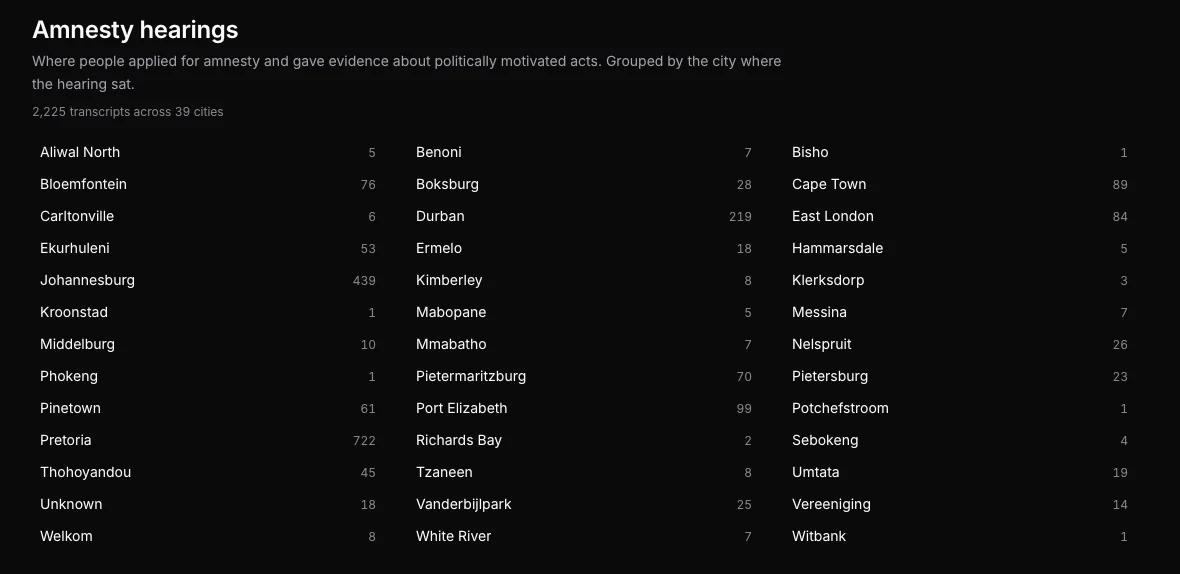
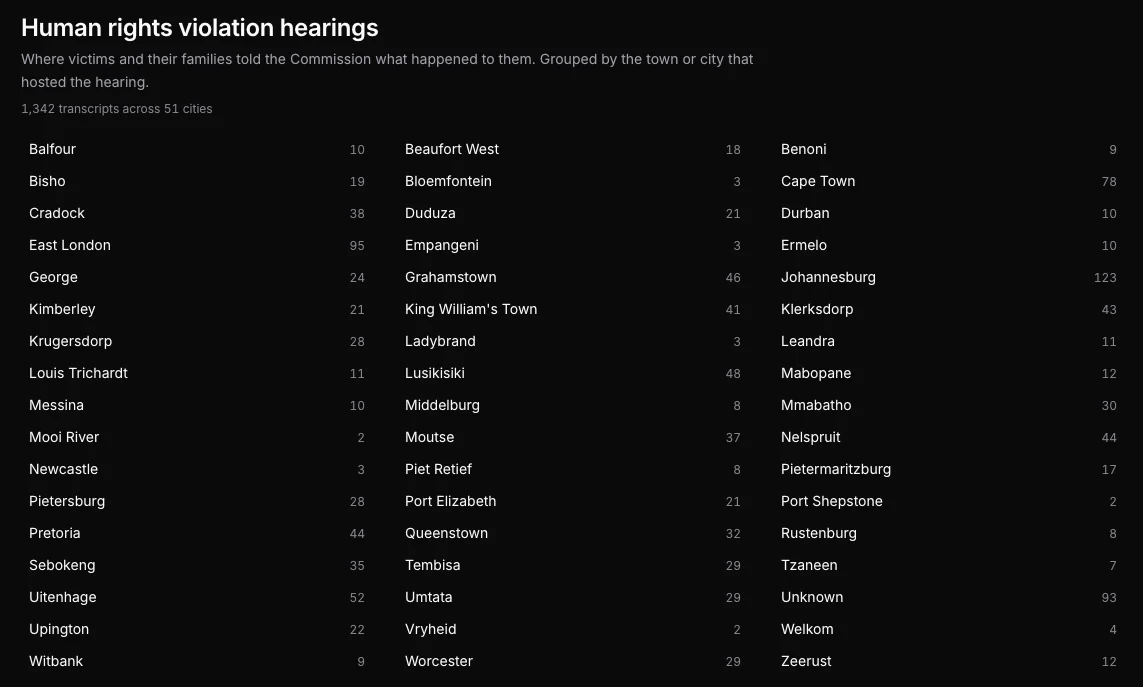
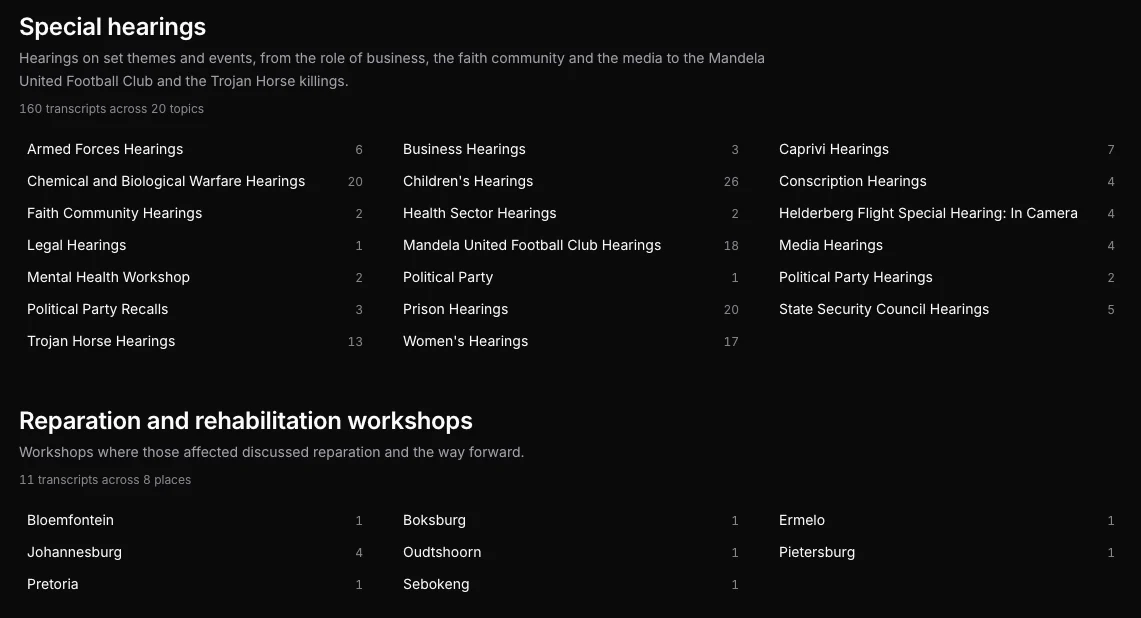
364 of those are archive index pages rather than individual hearings or decisions, which is why the hearing pages count slightly fewer transcripts: 2,225 amnesty hearing transcripts across 39 cities, 1,342 human rights violation hearing transcripts across 51 towns, 160 special hearing transcripts across 20 topics and 11 workshop transcripts across 8 places.
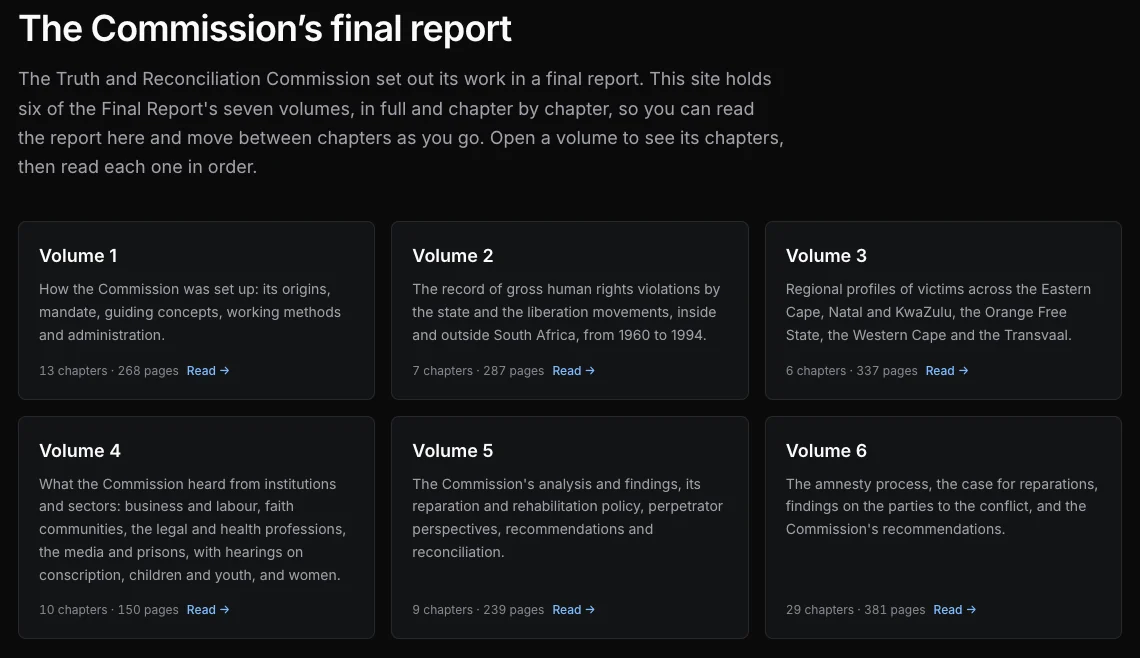
The archive also holds six of the Final Report's seven volumes, chapter by chapter: 74 chapters and 1,662 pages, from how the Commission was set up to the amnesty process and its recommendations.
Where the Commission went
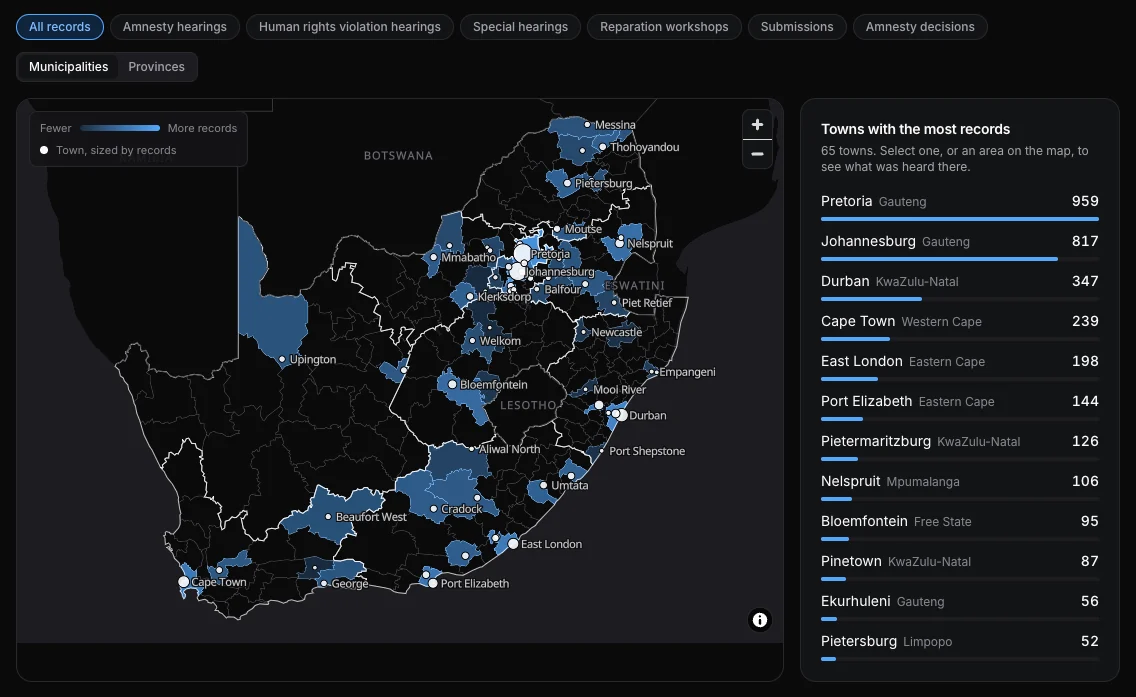
We placed every record that names a place on today's municipal map, keeping the town names the records use (Port Elizabeth, Pietersburg, Umtata). 65 towns appear. Pretoria holds the most records (959), then Johannesburg (817), Durban (347) and Cape Town (239). By province, Gauteng accounts for 44% of the 4,044 records with a mapped province, the Eastern Cape 17%, and the Western Cape and KwaZulu-Natal 11% each.
The split changes with the kind of hearing. Amnesty hearings concentrated in Pretoria (722 transcripts), Johannesburg (439) and Durban (219). Human rights violation hearings travelled much further, to 50 named towns, from Johannesburg (123) and East London (95) to Uitenhage, Lusikisiki, Cradock and Grahamstown.
Special hearings covered 20 topics, including children (26 transcripts), chemical and biological warfare (20), prisons (20), the Mandela United Football Club (18), women (17) and the Trojan Horse killings (13).
What happened to amnesty applications
The archive holds 1,088 amnesty decisions. 736 (68%) granted amnesty, 231 (21%) refused it and 114 (10%) granted it in part. Three were dismissed, one was reserved and three do not state an outcome.
One case, from hearing to decision
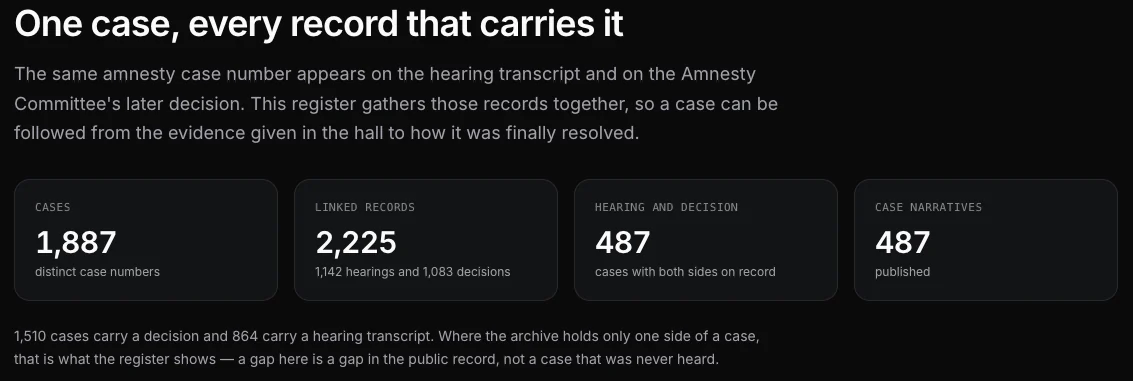
The most useful thing we built is the case register. The same amnesty case number appears on a hearing transcript and on the Amnesty Committee's later decision, but in the original archive they sit apart. We joined them.
- 1,887 distinct case numbers.
- 2,225 linked records: 1,142 hearing transcripts and 1,083 decisions.
- 487 cases with both the hearing and the decision on record. 1,023 have only a decision and 377 only a hearing. Where the archive holds one side, the register shows one side: a gap in the register is a gap in the public record, not a case that was never heard.
Each of the 487 complete cases has a case narrative: a plain-English account drawn from the linked records that sets out who applied, what the hearing covered, who sat on the panel and asked questions, and what the Committee decided. You can filter cases by outcome and by what is on record, and follow any case into its source documents.
How we built it
- Kept the source intact. Each document is stored with its original link, publisher, category, download date and a content fingerprint. We never overwrite what the source says with what we infer.
- Read every record the same way. A parser pulls a standard catalogue entry from each document: title, record type, dates, the people named and their roles, province, municipality, area and venue, case numbers and, for decisions, the outcome. 4,137 records name at least one person; 4,132 carry an explicit date.
- Left gaps as gaps. If a source doesn't state a person, date, place or outcome, the field stays blank.
- Summarised every record. A language model running on our own machine wrote a short summary of each record from that record's text alone. 6,783 of 6,869 records (98.7%) carry one. Summaries are a reading aid, not Commission text.
- Linked cases. Shared amnesty case numbers join hearings to decisions, and let us place 464 decisions on the map where their matter was heard.
- Made it searchable. Search covers names, places, case numbers, record IDs, titles and the full text of transcripts, decisions and reports, filtered by record type, province, outcome and decade.
- Put it in time. A timeline shows records by event date. Most hearings fall between 1996 and 2001.
What it doesn't claim
The standardisation is automated and complete; full manual review is not. Every record is marked “Not reviewed”, and the About page sets out the method and its limits. The source documents remain the property of the SABC and SAHA. Our catalogue and summaries are published under CC BY 4.0.
Explore it
- Start on the home page: the map, the timeline and the headline figures.
- Browse the source register by record type.
- Follow a case from hearing to decision.
- Search the archive.
- Read the Final Report.
If you work with an archive like this and want it catalogued, linked and searchable, see the Evidence Systems case study or email romanos@evidencesystems.co.za.