

The problem
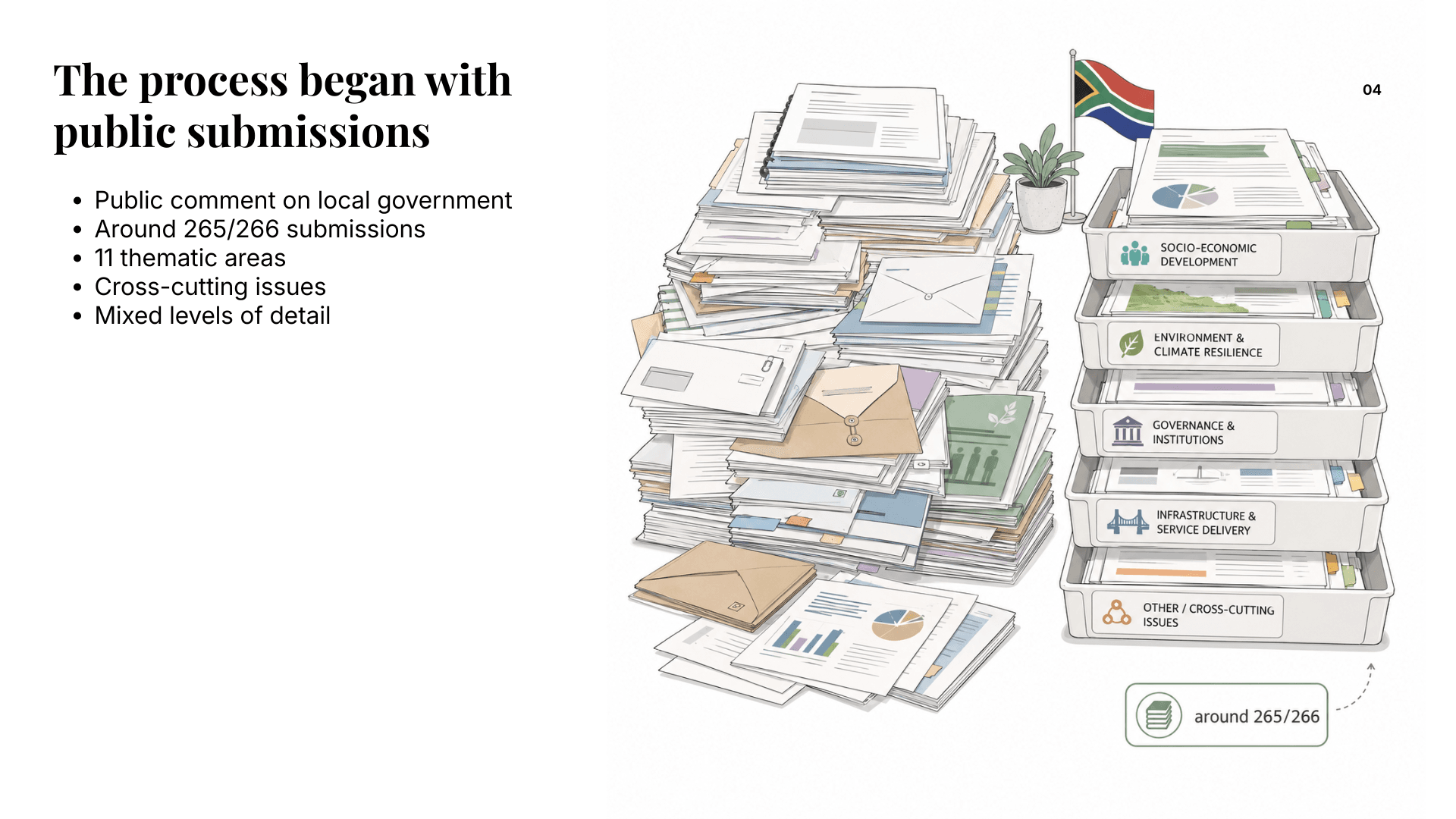
A national local government review needed one defensible route from public submissions to synthesis, drafting support, and later consultation review. Inputs arrived in mixed formats. Some were short and direct. Others were long, technical, repeated across sources, or politically sensitive. Specialist comments also had to be compared with public submission themes, while later review comments needed to stay visible after the draft White Paper entered public consultation. The real problem was not only volume. It was traceability under pressure.
Context
The engagement sat inside a high-scrutiny national review of local government in South Africa. The work had to hold up across public consultation, specialist review, drafting, and later comment handling, not just produce a one-off report.
Before and after
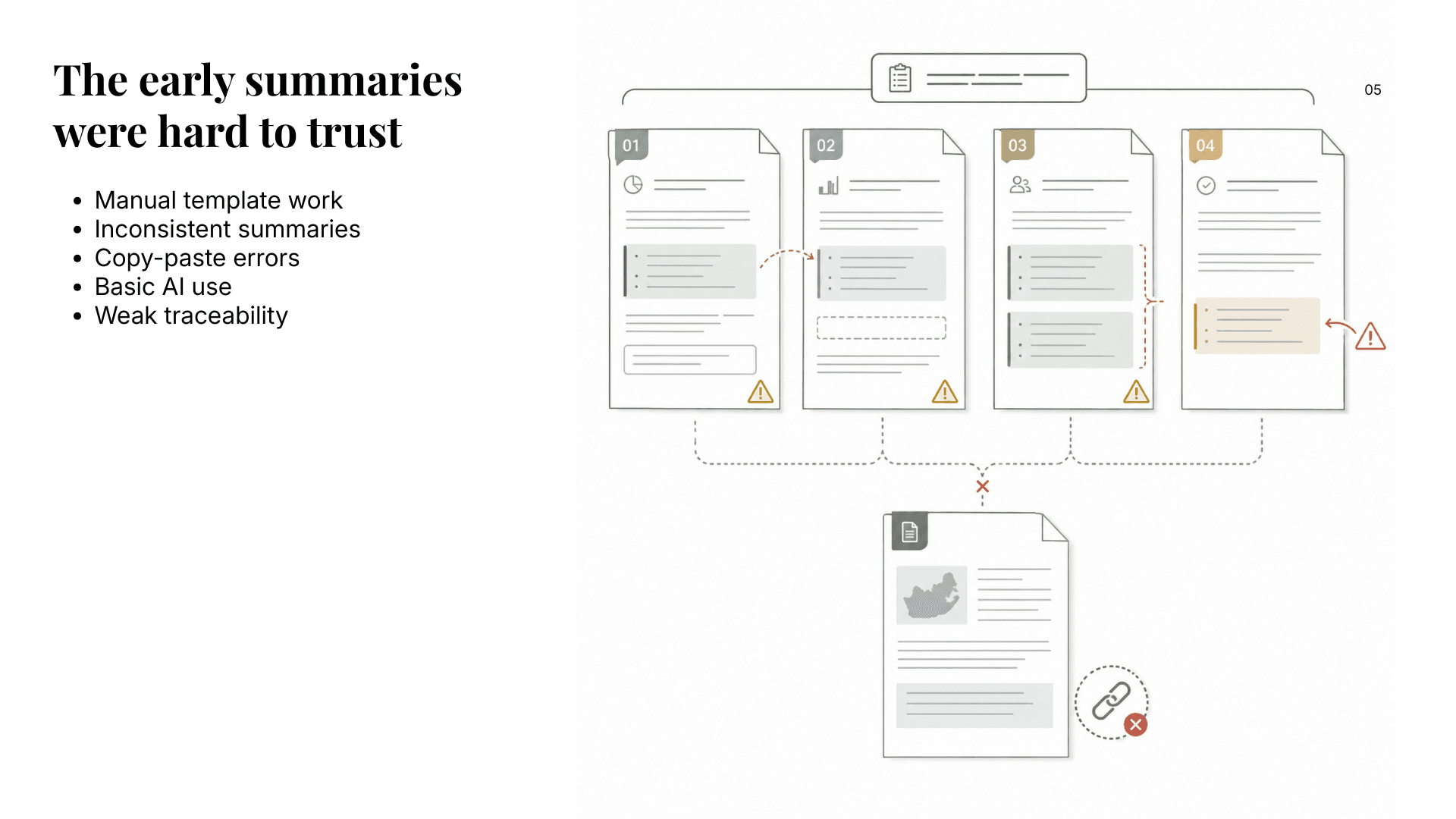
- Before: Public submissions, research inputs, specialist comments, and drafting material were spread across different formats. Useful points could be summarised, but the route from source text to claim, theme, drafting language, and review response was too easy to lose.
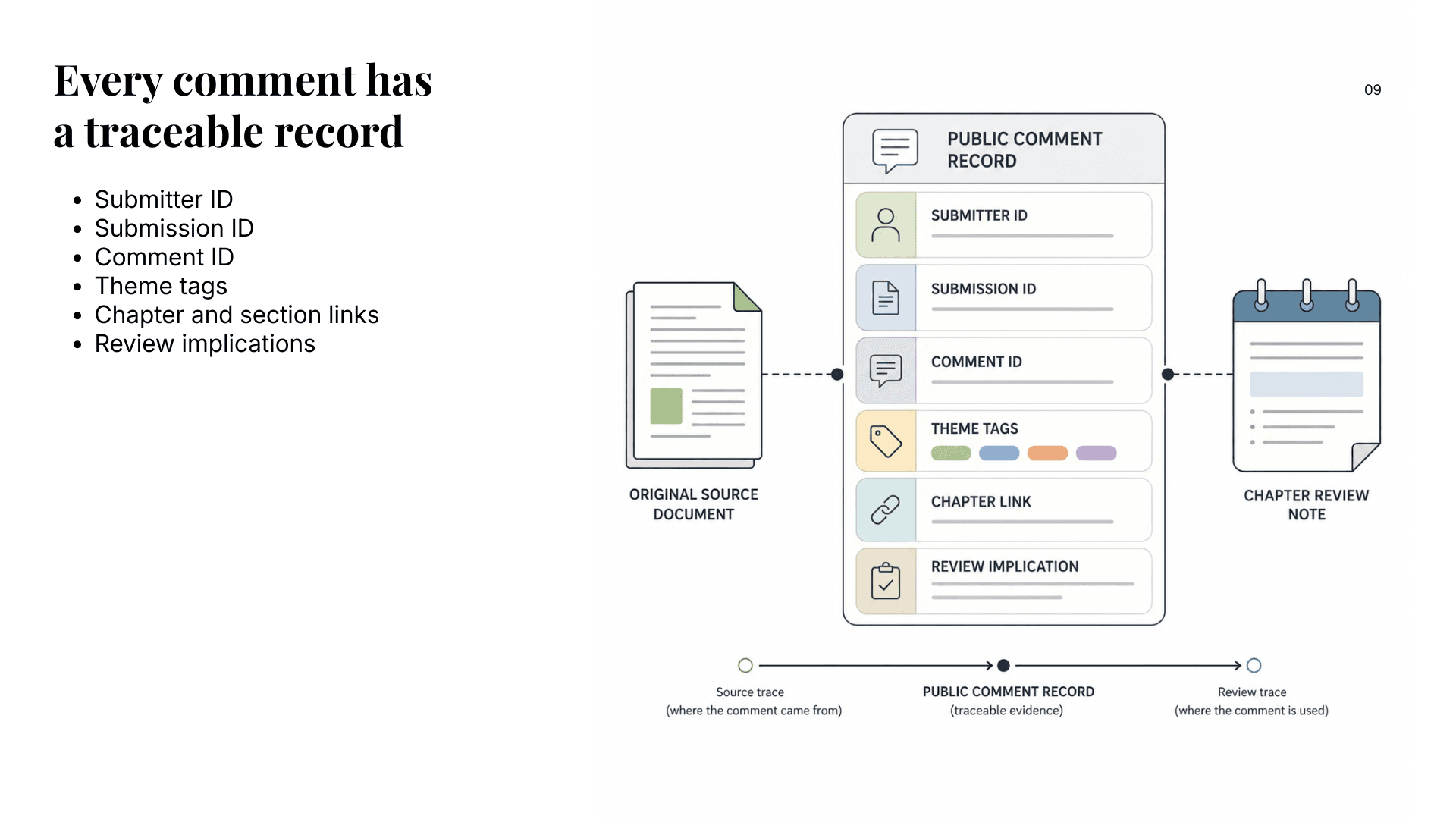
- After: Each useful claim could sit inside a structured evidence route: source, locator, theme, issue, synthesis output, drafting use, and review status. This made the material easier to retrieve, compare, reuse, and check during drafting and consultation review.
Constraints
The team could not rely on one-off summaries or scattered tracked changes. Each useful claim needed a source trail, and the drafting team needed a way to find relevant evidence quickly without losing context.
What the team needed
- A controlled intake and coding workflow for high-volume public submissions and later specialist review material
- A shared taxonomy and claims structure that linked every coded point back to source text
- Synthesis outputs the team could reuse across themes, drafting rounds, and policy optioning
- Fast retrieval for drafters without losing attribution or review history
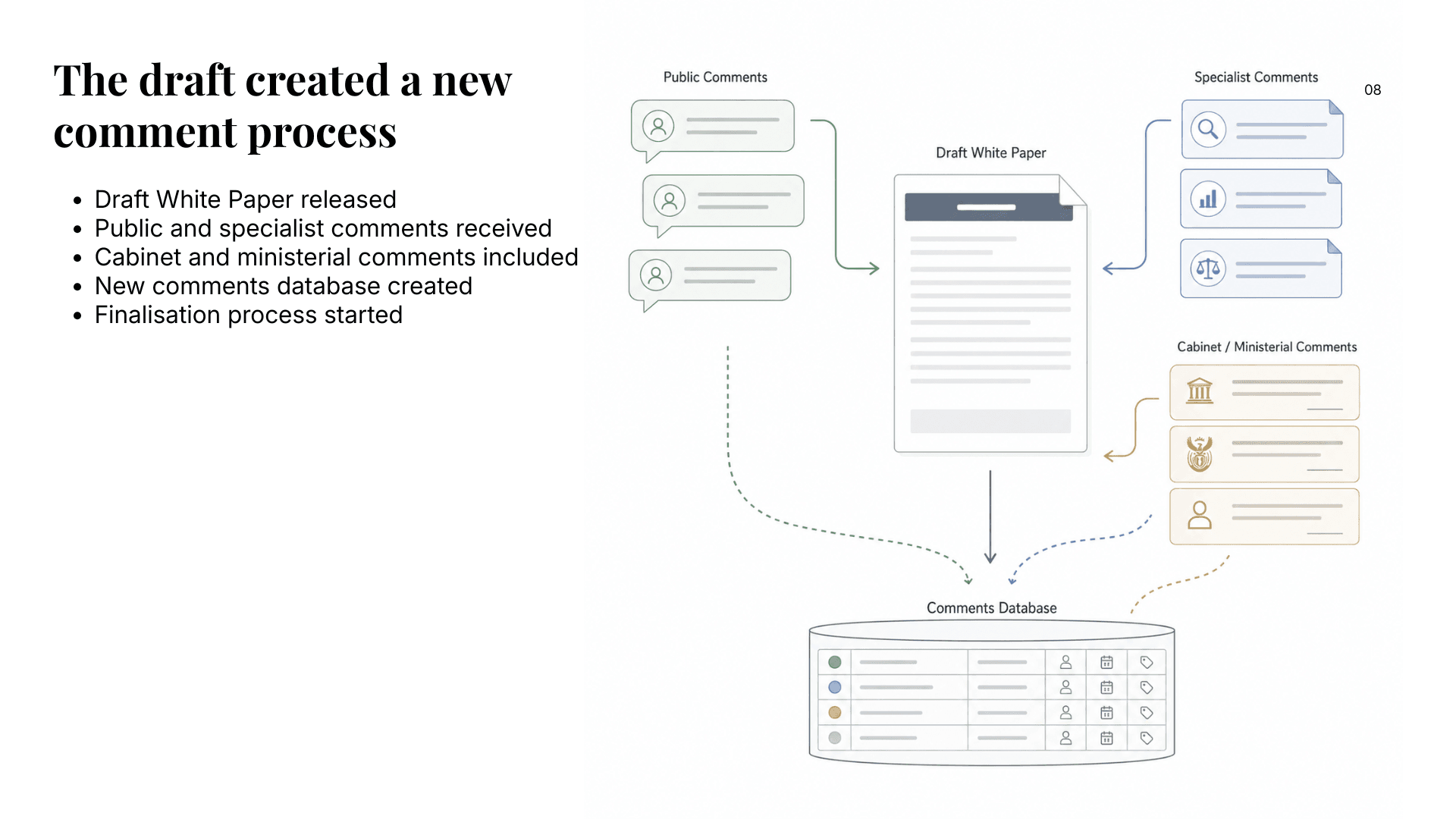
- A review-comments system that kept consultation feedback visible after the draft white paper was released
For a rough version of this problem in your own team, test your source-traceability risk before the workflow reaches drafting and review.
What I built
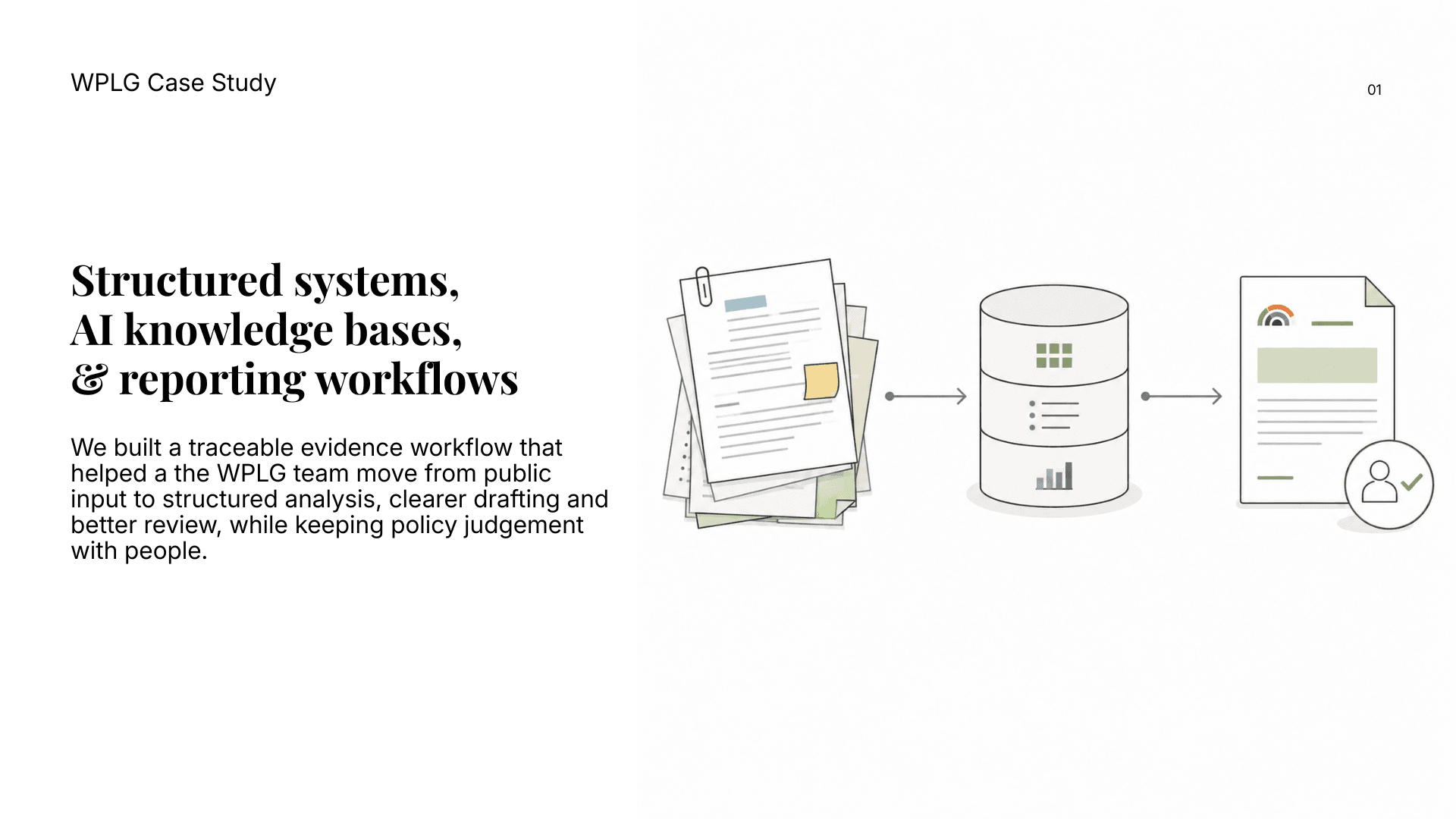
A traceable policy evidence workflow spanning controlled intake, claims coding, thematic synthesis, retrieval support, draft White Paper support, and a coded review-comments database.
Named systems and workflow pieces
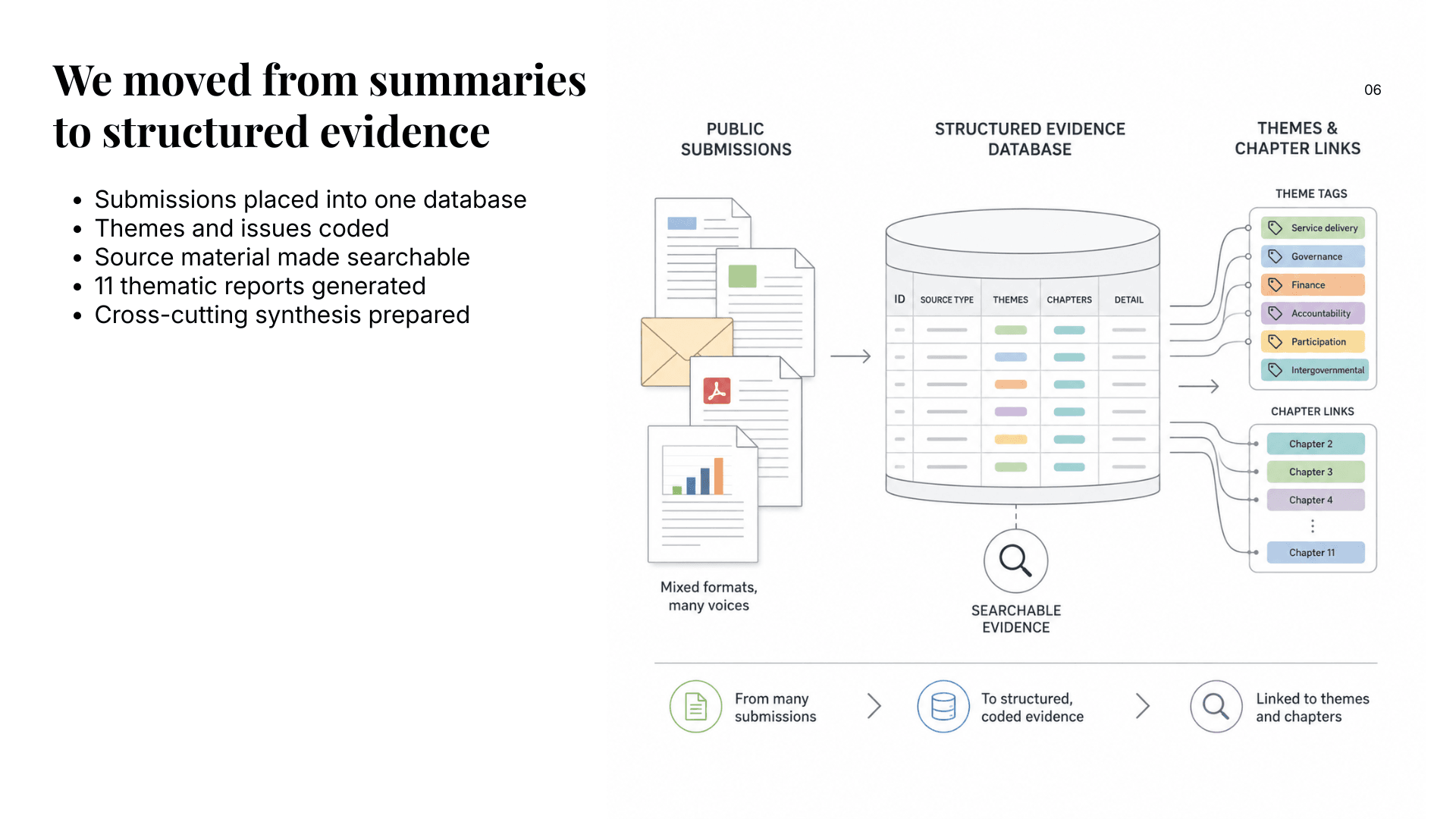
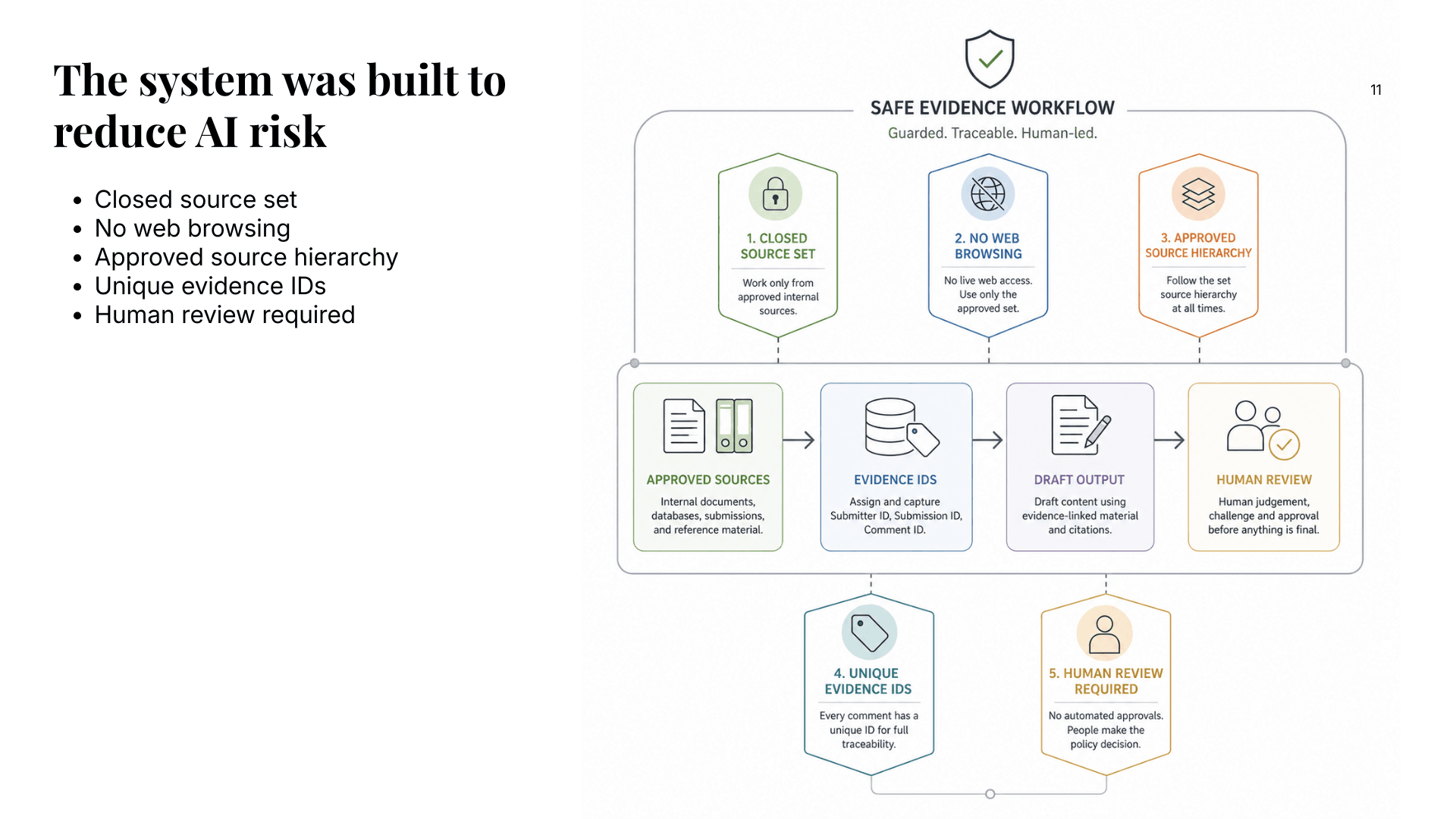
- Controlled intake, metadata capture, dedupe checks, status tracking, and review flags across mixed inputs
- A structured claims database with taxonomy, quote fields, source locators, and audit-ready traceability
- A 100-page integrated synthesis and 11 thematic reports for specialist review and drafting
- Triangulation views comparing public submission signals with specialist signals
- An interactive evidence assistant for retrieval, drafting support, and side-by-side comparison
- Draft White Paper support that kept drafting points connected to structured evidence
- A live coded review-comments database for consultation feedback, with the review phase still active
Where this connects to the services
This case study sits mainly under Traceable Evidence Workflow Support because the project needed source IDs, claim coding, quote locators, theme structures, synthesis outputs, retrieval support, and review tracking. It also touched Data Collection & Intake Systems at the intake layer and Data Use, Reporting & Communication Systems at the output layer, where coded evidence needed to become synthesis packs, thematic reports, drafting support, review notes, and reusable evidence outputs.
One system linked evidence, drafting, and review
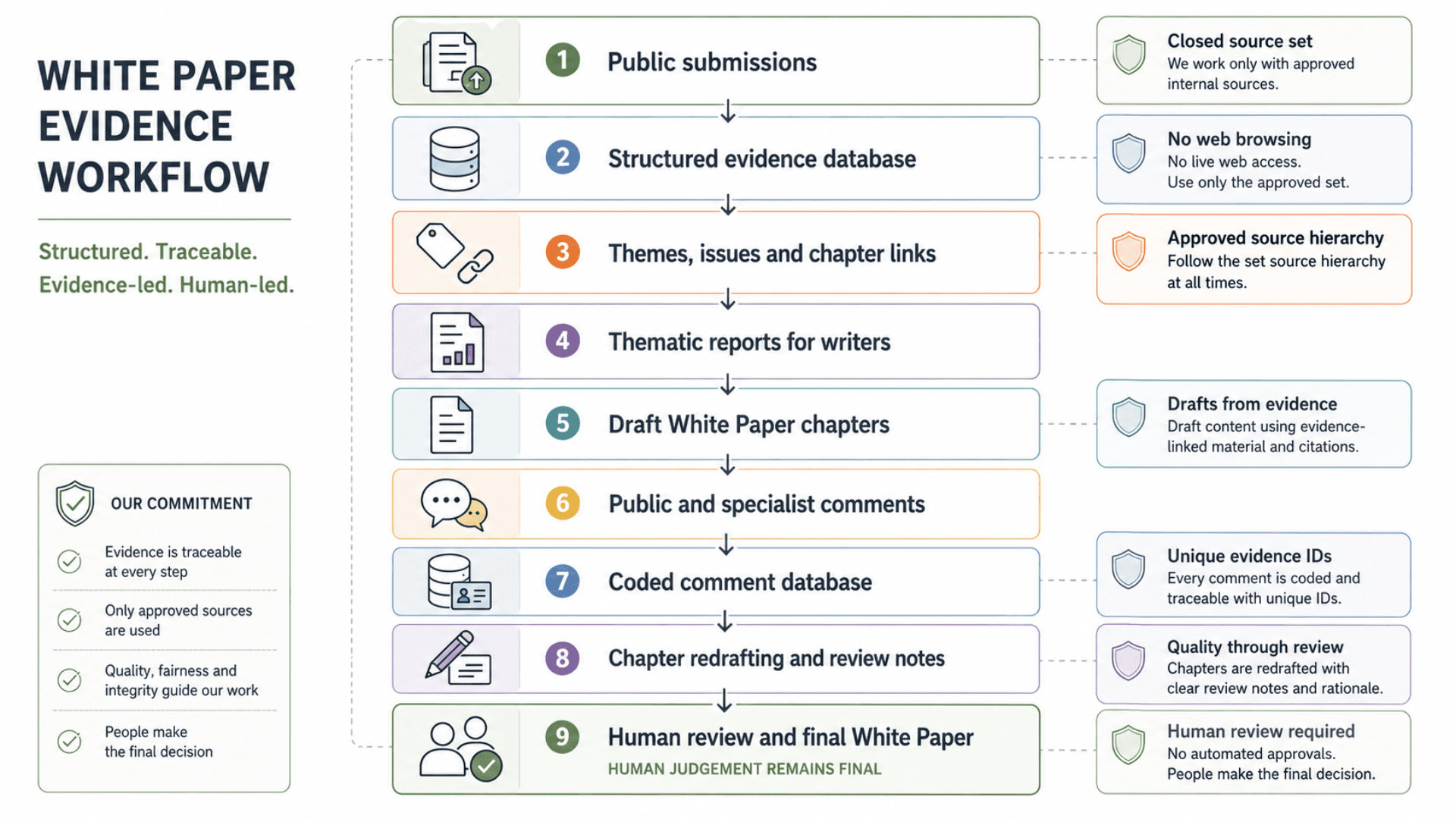
The workflow kept submissions, thematic synthesis, drafting, and consultation comments inside one traceable chain instead of splitting them across folders and tracked changes.
Public submissions and specialist inputs entered a controlled intake with metadata, status, and source locators.
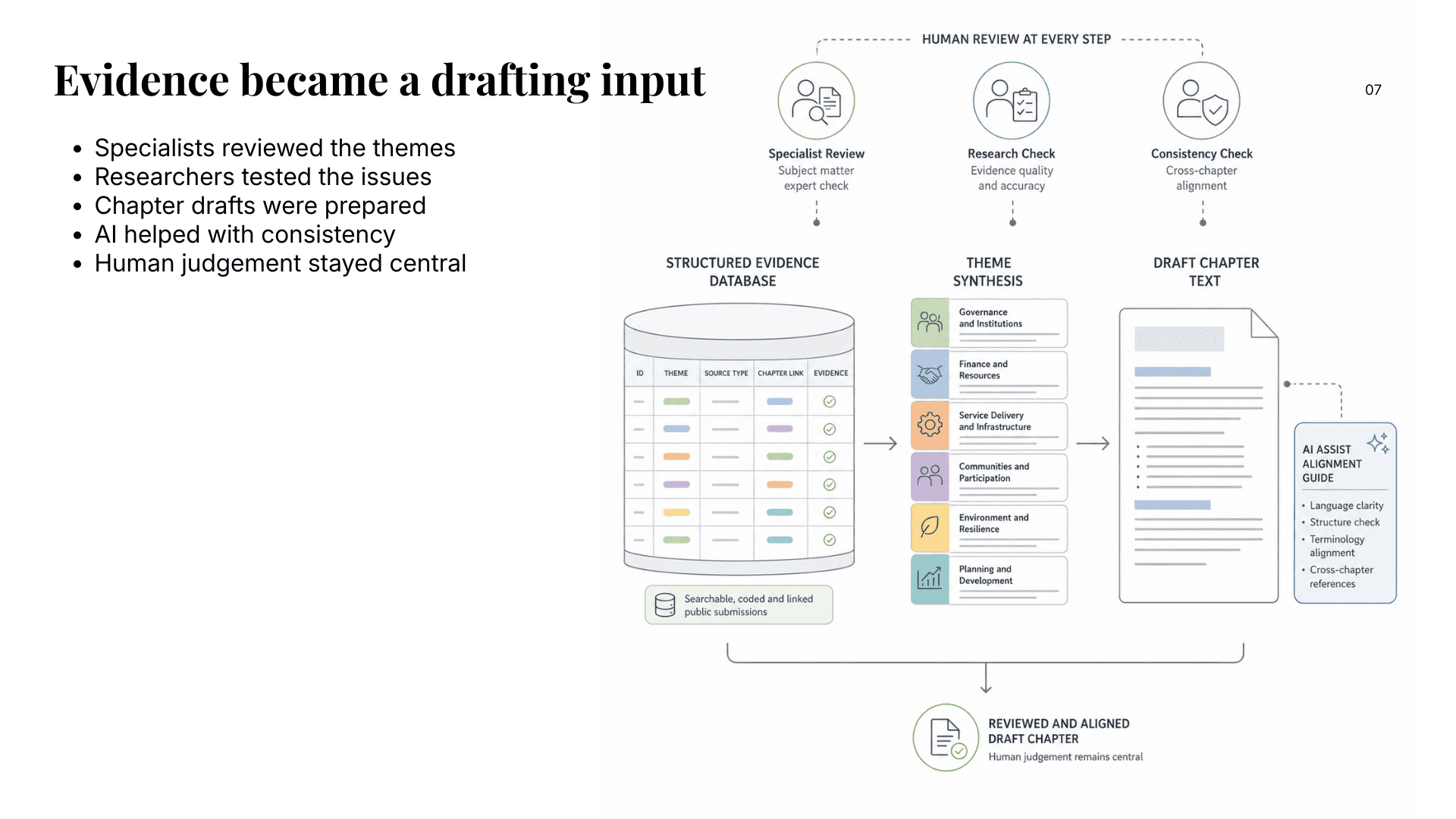
Claims, themes, and issue patterns rolled up into a 100-page pack and 11 thematic reports.
Drafters could retrieve evidence, compare signals, and use structured material during February 2026 draft White Paper support.
Consultation feedback moved into a live coded comments database instead of disappearing into tracked changes.
Submission to coded claim to synthesis pack to draft white paper to coded review comment
How it worked
The workflow moved from raw material to usable output through a short sequence of controlled steps.
Process
- 01
Collected and cleaned mixed-format submissions into one controlled intake workflow
- 02
Turned submissions into discrete claims with themes, quotes, and locators
- 03
Produced synthesis packs, ranked issue lists, and cross-theme summaries for review
- 04
Compared public submission patterns with specialist commentary
- 05
Built retrieval support so drafting could stay tied to the coded evidence base
- 06
Linked draft White Paper support back to evidence and tracked review comments in the live database
Outputs
These were the named assets, dated deliverables, and working materials left behind by the project.
Working outputs
- Claims and evidence database with traceable source locators
- 100-page integrated synthesis pack
- 11 thematic reports plus cross-cutting synthesis
- Interactive evidence assistant
- February 2026 draft White Paper support
- Live coded review-comments database
Result
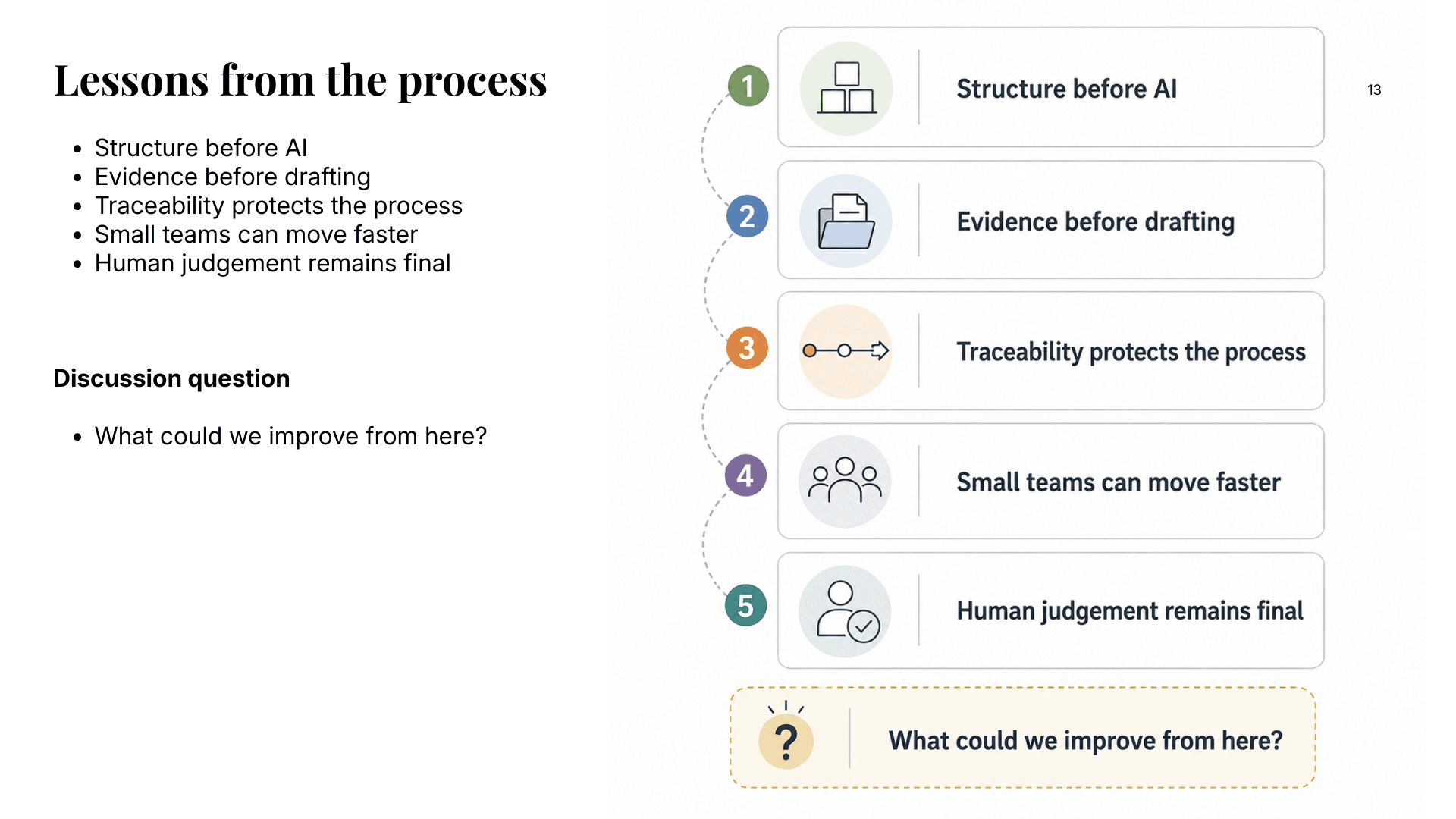
Evidence capture, synthesis, drafting support, and consultation review stayed connected instead of being split across folders, notes, tracked changes, and one-off summaries.
Main result
- Built the evidence workflow behind a national White Paper draft process and moved the project into a live coded review phase
- Produced a 100-page integrated synthesis and 11 thematic reports that the team could reuse across drafting and review
- Supported the February 2026 draft White Paper process without losing traceability back to public and specialist inputs
- Replaced scattered comment handling with a coded review workflow that could survive consultation
- Left the team with reusable assets for drafting, review, and finalisation
Policy drafting support gets stronger when evidence capture, synthesis, drafting, and review comments stay inside one linked system instead of being split across folders, tracked changes, and one-off summaries.
What this proves
- Public submission analysis for high-scrutiny policy and consultation processes
- Source registers and claims databases that keep evidence tied to source text
- Issue and theme coding with quote and locator tracking
- Synthesis packs and thematic reports that can support specialist review and drafting
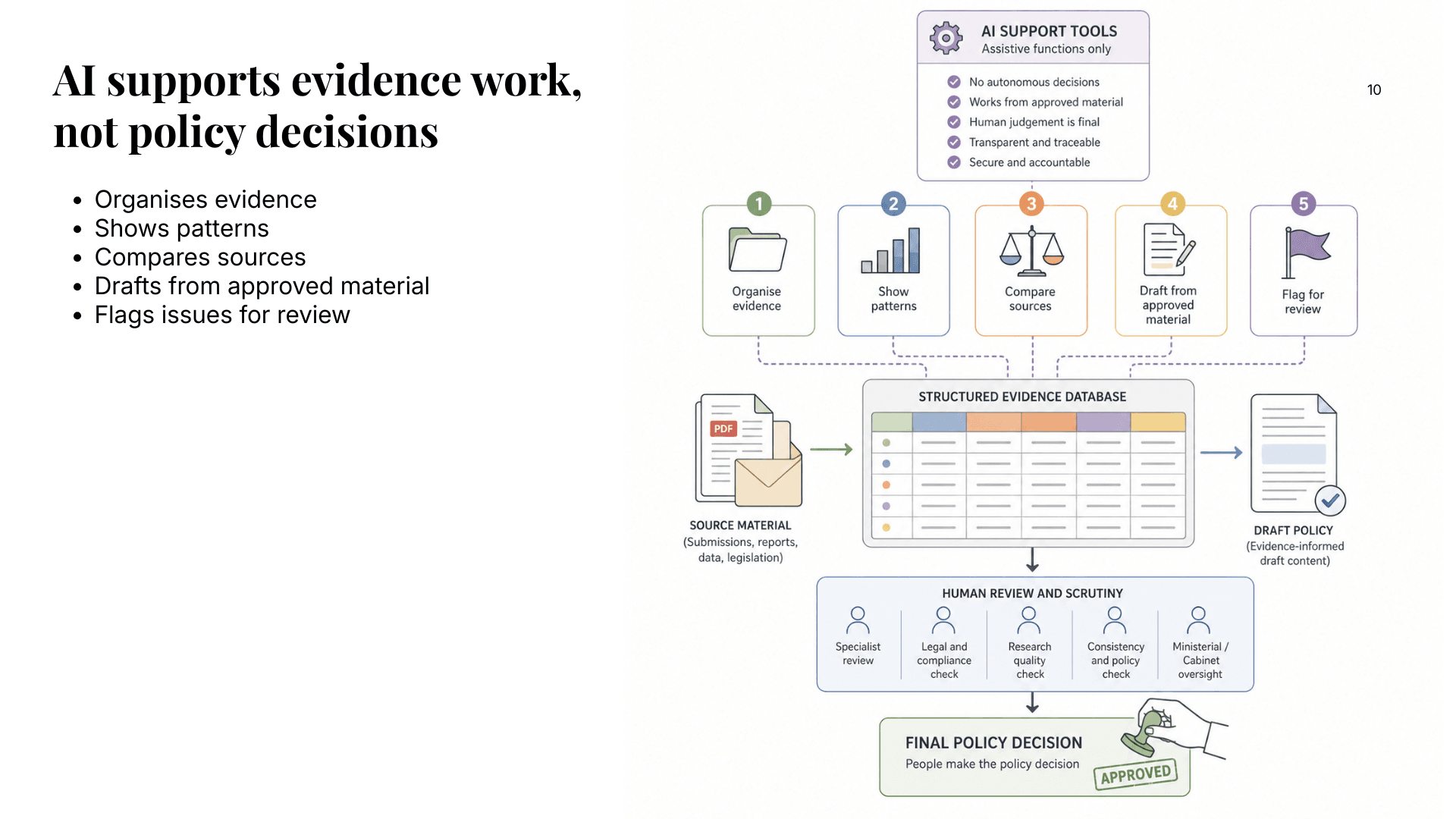
- AI-supported retrieval around approved source material with human review in the workflow
- Coded review-comment handling through consultation and finalisation
Best fit
These are the situations where this kind of evidence workflow tends to be the strongest fit.
Who this is best for
- Public consultation projects where submissions arrive in different formats
- Policy drafting teams that need claims to stay linked to source text
- Research programmes where themes need to support synthesis and drafting
- Review-heavy projects where comments cannot disappear into tracked changes
- Teams that need a defensible record for public-sector or specialist review
Service stack connected to this case study
This case study sits inside the same delivery work, service logic, and practical outcomes shown across the site.
Turn interviews, submissions, case studies, survey comments, documents, and field notes into coded evidence, quote banks, synthesis tables, findings, recommendations, and report-ready outputs.
Use structured data in reports, dashboards, internal tools, public microsites, applications, presentations, annual reports, and decision-support workflows.
Collect useful, traceable data from the start through forms, fieldwork tools, public submission portals, partner reporting systems, calculators, and intake workflows.