
- Interviews, case studies, field notes, survey comments, or source documents are sitting in different formats.
- There is no consistent coding framework or thematic matrix.
- Report writers cannot easily see which evidence supports each finding.
- Useful quotes and examples are buried in long notes or transcripts.
- The team needs report-ready outputs without losing source links or review judgement.

Research data synthesis support for qualitative evidence and report outputs
The research may already be collected, but the findings are not yet usable. I help turn interviews, case studies, field notes, survey comments, source documents, and focus group material into structured evidence that writers and project leads can work from.
The problem
The research is collected, but the findings are not yet usable.
This offer is for teams with qualitative material that is too large, uneven, or inconsistent to turn into findings quickly.
Who this is for
Research teams that need structured synthesis support
The strongest fit is a research or evaluation team that has collected material and now needs a clearer route to findings and writing.
Research firms and evaluation teams
For teams handling qualitative datasets, mixed source material, or case study evidence that needs to become findings, tables, and report-ready summaries.
UNICEF and donor-funded contractors
For lead consultants and report teams working under donor standards, review deadlines, and source traceability expectations.
Lead consultants and report writers
For teams that need synthesis outputs they can draft from without rereading every source manually.
Related services
This offer sits under Data Synthesis
The page is a focused buying route for qualitative material. Related product pages cover broader evidence-to-report and AI retrieval needs.
Data Synthesis
The parent service for turning multiple evidence streams into themes, findings, quote banks, tables, and report-ready outputs.
View Data SynthesisReport Writing
Useful when synthesis outputs also need to move into findings sections, recommendations, summaries, or draft report content.
View Report WritingDatabase Architecture
Useful when the material first needs a source tracker, coding structure, data dictionary, or evidence table.
View Database ArchitectureEvidence, Insight & Reporting Engine
Use this broader route when the project needs synthesis, recommendations, report sections, QA, and source checking in one workflow.
View the reporting engineAI Knowledge Base Build
Use this when the synthesis workflow also needs controlled retrieval, custom GPT support, or source-linked querying.
View AI Knowledge Base BuildSource material
Common inputs for research synthesis
The source material can be messy. The work creates a structure that can survive review and support writing.
Qualitative material
- Interviews
- Focus groups
- Case studies
- Field notes
Open-ended responses
- Survey comments
- Stakeholder inputs
- Workshop notes
- Consultation material
Supporting source documents
- Reports
- Briefing notes
- Existing evidence tables
- Draft findings
What I build
Structured synthesis outputs for researchers and writers
The work can include a source tracker, coding framework, evidence table, quote bank, thematic matrix, cross-case synthesis, grouped themes, finding summaries, gap notes, recommendations support table, report-ready outputs, and QA notes.
AI can support parts of the process where appropriate, but it does not replace the research lead, subject-matter judgement, or review of claims against source material.
Workflow snapshot
Bring multiple evidence streams into one coherent view.
Best when interviews, studies, notes, and submissions need to be compared, grouped, and turned into findings.
How the work moves
The workflow turns raw qualitative material into report-ready evidence
The structure is designed around the research questions, coding depth, reporting deadline, and outputs the writers need.
Review the questions and source material
I review the research questions, material types, rough volume, report outline, priority themes, and deadlines.
Set the coding and evidence structure
I create or refine the coding framework, source tracker, evidence table, quote fields, theme labels, and review notes.
Synthesize themes and findings
I organise the material by theme, case, location, group, question, or issue, then prepare finding summaries, quote banks, and comparison tables.
Prepare outputs for writing and review
I prepare report-ready tables, draft findings support, recommendations notes, gap notes, QA notes, and handover material.
Deliverables
The deliverables help the team move from collected material to usable findings
The exact mix depends on how much material exists, how deeply it must be coded, and what the report needs to contain.
- Source tracker
- Coding framework
- Evidence table
- Quote bank
- Thematic matrix
- Cross-case synthesis
- Finding summaries
- Grouped themes and gap notes
- Recommendations support table
- Report-ready outputs
- QA and review notes
Where this fits
Where synthesis support fits
This is a focused route for teams that already have the data and need help making it usable for analysis and writing.
UNICEF and donor-funded reports
Turn case studies, interviews, notes, and supporting documents into source-linked findings, tables, and draft-ready outputs.
Evaluation and situation analysis work
Create a structured evidence base that helps teams compare themes, service issues, respondent groups, locations, and recommendations.
Qualitative research overflow
Support research teams when the amount of material is too large for the current team to code, compare, and summarise within deadline.
Careful AI use
How AI can support synthesis without replacing judgement
AI can reduce some manual handling, but the synthesis still needs coding discipline, source links, and review.
First-pass organisation
AI can help with first-pass summaries, classification, comparison, and retrieval when the source IDs and coding framework are clear.
Human review remains central
Claims, findings, quotes, gaps, and recommendations should still be reviewed by people who understand the research context.
Source traceability is built in
The workflow keeps source IDs, quote fields, theme labels, and review notes visible so writers can check where a finding came from.
Client inputs
What the client needs to provide
A short scoping call is easier when the team can show the material and the output it needs to support.
Research material
Interviews, focus groups, field notes, case studies, survey comments, workshop notes, source documents, and existing coding notes.
Research and reporting context
Research questions, methodology requirements, report outline, donor or client standards, priority themes, and review comments.
Delivery constraints
Deadline, review process, required output formats, tool environment, confidentiality requirements, and team roles.
Proof
Related case studies
These case studies show research synthesis under donor-funded and public-sector reporting conditions, with evidence structures that support writing and review.
Calculators
Use these tools if you need to diagnose the workflow first
The strongest calculator fit depends on where the pressure sits: search, capacity, traceability, reporting drag, or knowledge-base value.
Related reading
Useful guides before you scope the work
These articles explain the thinking behind the service and the adjacent workflow problems.
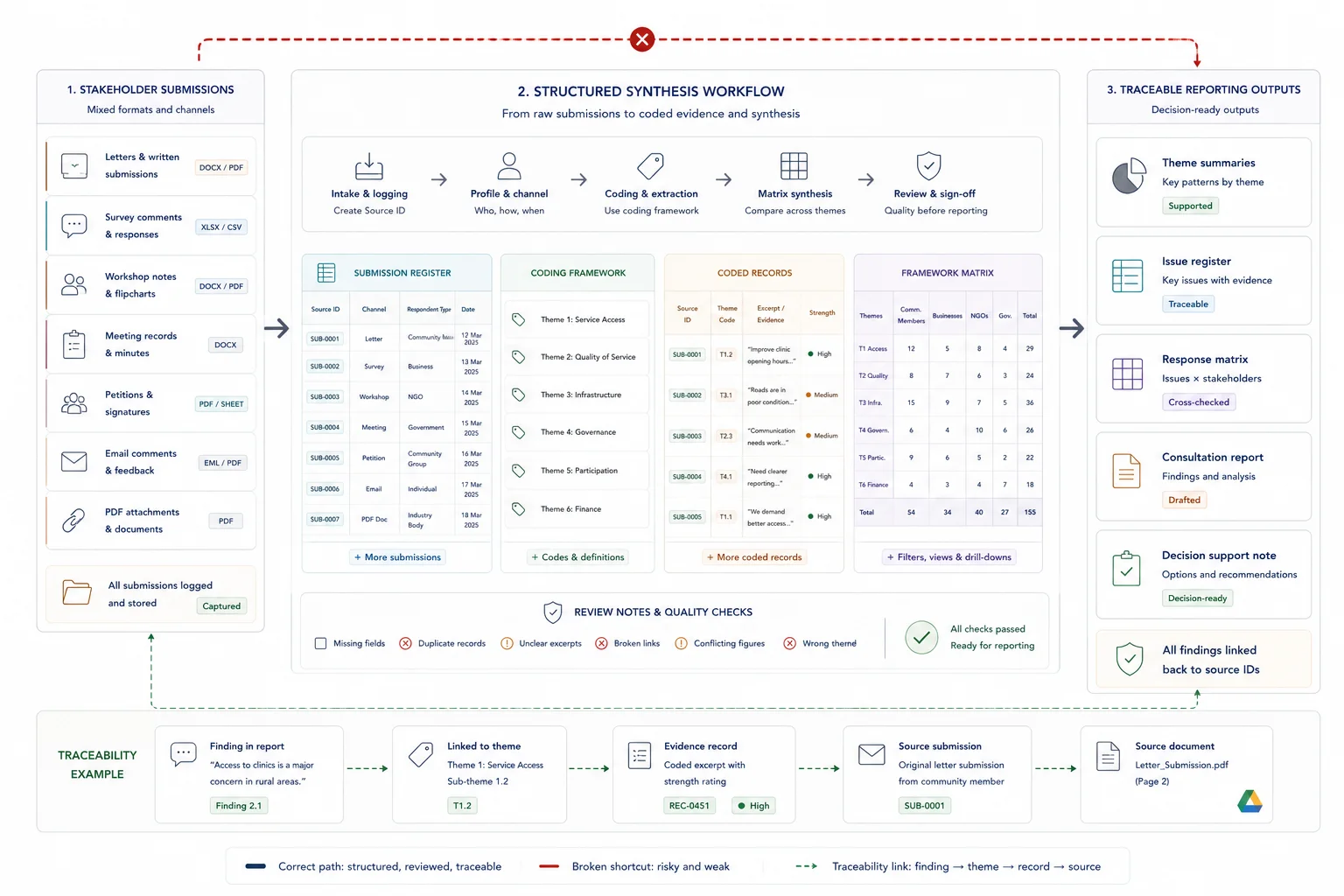
How to Synthesise Stakeholder Submissions Without Losing Source Traceability
Synthesise stakeholder submissions with source IDs, coding, framework matrices, and QA for traceable, defensible reporting.
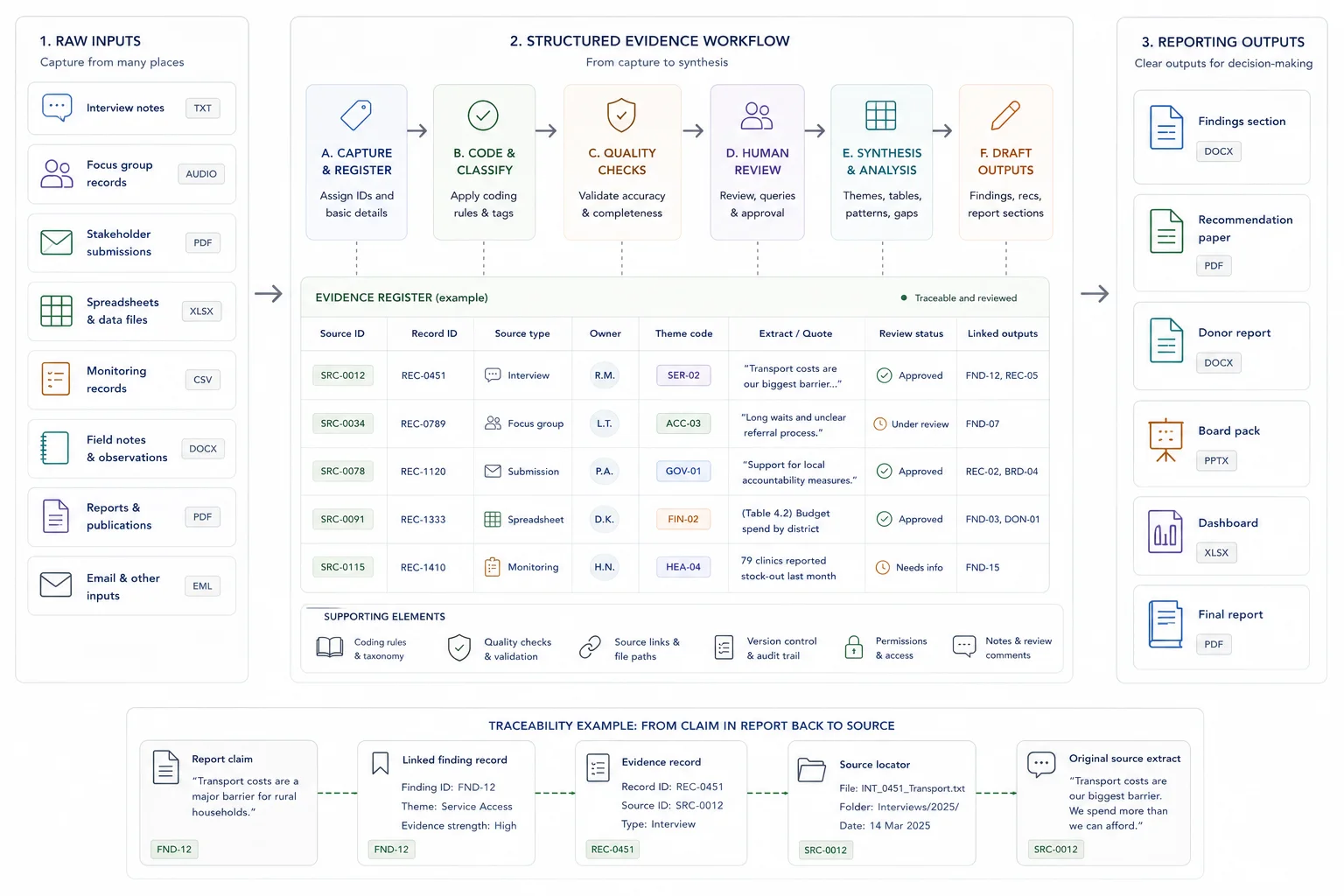
How to Build Evidence Workflows for Reporting and Accountability
Learn how to build evidence workflows that improve reporting, source traceability, and decision-ready findings.
Frequently asked questions
Questions before you enquire
Do you replace the research lead?
No. I support the evidence structure, synthesis workflow, findings material, and report-ready outputs. The research lead and subject-matter experts remain responsible for judgement and sign-off.
Can you work from messy notes?
Yes, but the quality of the output depends on the quality and completeness of the notes. Messy material can be structured, but missing information should be flagged rather than hidden.
Can this feed into report writing?
Yes. The synthesis can be designed to produce finding summaries, tables, quote banks, recommendations support, and draft-ready sections for report writers.
Can AI help with qualitative synthesis?
AI can support first-pass organisation, summaries, comparison, and retrieval where appropriate. It still needs coding rules, source traceability, and human review.
What should I send before a scoping call?
Send the source types, rough volume, research questions, reporting deadline, current coding structure if one exists, and the output the synthesis needs to support.
Let's talk
Send the research material, questions, and output needed
If the team has collected interviews, case studies, notes, or documents but needs help turning them into themes, findings, tables, and report-ready outputs, send the source types, volume, deadline, and report context.