

Strong reports do not fail only because the writing is weak. They fail when the logic between evidence, findings, conclusions, and recommendations is hard to follow.
A reporting workflow is the practical route from source material to reviewed output.
A team may have plenty of source material and even a decent synthesis layer, yet the final report still falls flat because the narrative is unclear, caveats disappear, appendices carry the wrong material, or recommendations drift beyond what the evidence can support.
This guide is about report logic. It shows how to move from prepared evidence into findings, how findings become conclusions, how conclusions become recommendations, and how to keep the result readable under review.
Quick answer
A report writing workflow is the process that turns source material, analysis, review, and decisions into a clear final report. It should define the audience, report logic, evidence base, drafting sequence, review responsibilities, version control, and sign-off steps. Strong report workflows reduce late rewrites because claims, findings, recommendations, and review notes stay organised from the start.
Who this guide is for
This guide is for consultants, researchers, evaluators, public-sector teams, and donor-funded project teams that need to produce evidence-heavy reports under review pressure.
It is especially relevant if you are dealing with:
- Reports move slowly because source material, comments, and drafts are scattered
- Findings and recommendations are difficult to check against evidence
- Several reviewers need to comment without breaking the structure
It is less relevant if:
- You only need a short narrative write-up with little evidence checking or review
Key takeaways
- Main principle: define the reporting argument early so the draft does not have to discover the logic by accident.
- Operational consequence: findings, conclusions, and recommendations stay visible as separate layers instead of collapsing into one blended narrative.
- Review consequence: readers can follow the route from evidence to interpretation to action without guessing what happened in between.
What a report writing workflow includes
A good report writing workflow covers more than drafting. It includes scope, audience, source material, evidence structure, section logic, review rounds, version rules, and final checks. The writing is only one part of the system.
What good looks like
| Weak setup | Stronger setup |
|---|---|
| The report starts with a blank document | The report starts with a clear structure, evidence map, and section purpose |
| Claims are added as drafting progresses | Claims are pulled from reviewed evidence and linked to sources |
| Review comments live across files and emails | Review points are tracked in one place with status and owner |
| Recommendations are drafted at the end | Recommendations follow from findings, implications, and agreed decision logic |
Where this fits in the wider workflow
| Workflow stage | What happens |
|---|---|
| Input | Evidence base, analysis notes, interview material, datasets, client requirements, and report brief |
| Structure | Report outline, section logic, evidence matrix, claim register, version rules, and review tracker |
| Review | Evidence checks, editorial review, technical review, client review, and final sign-off |
| Output | Reviewed report draft, final report, recommendations, annexes, and source-backed findings |
Why report-writing workflows matter
Good reports are not rescued at the end. They are made possible by a workflow that decides early what counts as evidence, how it will be reviewed, and how it will be carried through to writing and action.
Report quality depends on visible logic, not just good prose
Strong report writing starts earlier than most teams expect. CDC's evaluation framework treats evidence planning as its own step: teams clarify what evidence is needed, how it will be gathered, and from whom before they try to interpret the results. NICE's guideline manual on reviewing evidence reaches the same conclusion from guideline development by describing evidence review as an explicit, systematic, and transparent process. GOV.UK's analysis standard makes the operational version of the same point by describing analysis as a defined cycle from scoping through delivery and sign-off.
The practical lesson is simple. If the evidence need, unit of analysis, source types, and review expectations are still unclear, the report is not really ready to be written yet. The team may be able to open the template, but the logic of the report is still unstable.
Workflow quality shows up when review pressure rises
Weak workflow often stays hidden until someone asks a hard question. Where did this claim come from? Which subgroup does it apply to? Was this theme widespread or just vivid? What did you exclude? What supports this recommendation?
That is why review-heavy projects need more than fluent writing. They need a route back to the evidence. If this is the recurring pain, you can test the source-control risk behind review pressure before redesigning the drafting route. The South African Local Government White Paper case study shows what that looks like in a live consultation and drafting environment: source locators, quote fields, thematic synthesis, drafting outputs, and later review comments all sitting in one connected system. In the UNICEF Palestine situation analysis, the same logic made it possible to draft under time pressure without losing the line from source material to findings and recommendations.
A good workflow does not remove scrutiny. It makes scrutiny survivable.
This is about defensibility as much as efficiency
Speed is a benefit, but it is not the main reason to design the workflow properly. The real gain is defensibility.
When evidence handling is weak, teams often do the same work twice. They analyse once during coding or note-taking, then again while drafting, then again during review because the first two passes did not preserve enough traceability. That is part of the wider pattern described in The Real Cost of Messy Evidence Workflows: the system creates avoidable rework long before the deadline becomes visible.
A report-writing workflow earns its keep when it lets the team answer questions quickly, revise sections safely, and keep recommendations anchored to the material instead of to memory.
Define the reporting argument before anyone opens the template
Before the draft starts, the team should know what the report is trying to establish, what the main questions are, where the evidence is strong or qualified, and what kind of action the document needs to support.
That does not mean writing the report early. It means making the reporting logic visible early enough that the draft is not forced to discover it by accident.
Start with the output and the evidence question
Before drafting, define:
- what the report has to help the audience decide or do
- which questions the report must answer
- what evidence is in scope
- which channels or source types feed the report
- which subgroups, geographies, or time periods matter
- what level of traceability reviewers will expect
This is where teams decide the unit of analysis as well. It may be a submission, an interview, a case, a site visit, a respondent group, a policy question, or a coded claim. That choice shapes the entire workflow.
If the workflow mixes unlike material too early, later reporting becomes muddy. That is one reason the broader evidence-workflows guide starts with outputs and source mapping rather than with software.
Put practical controls in place at intake
This is the control layer that turns a folder of material into a report-ready evidence system.
Once the output is clear, set up the controls the drafting team will need later. Gale's Framework Method paper is useful here because it treats charting and memoing as part of a systematic analytic process rather than as admin afterthoughts. The NSW Health qualitative analysis guide adds the practical layer that makes that usable in live projects: a tracking log, source IDs, a codebook, file rules, and an audit trail.
At minimum, most evidence-heavy report workflows benefit from:
- stable source IDs
- a live source register or tracking log
- version and status fields
- quote or excerpt locators
- a controlled codebook or theme list
- memo notes on analytic decisions
- clear ownership of review and sign-off
The UNICEF Zambia evidence workflow shows why this matters. Quote-per-claim guardrails and spreadsheet-friendly traceability made it easier for non-technical writers to produce report-ready outputs without detaching the text from the source base.
Mini example: one row in a report-ready evidence register
The exact tool can vary. What matters is that each record carries enough context for retrieval, comparison, and later drafting.
| Field | Example value | Why it matters |
|---|---|---|
| Source ID | INT-014 | Creates one stable route back to the source |
| Source type | Key informant interview | Keeps unlike evidence channels visible |
| Report question | Referral barriers | Links the record to the output the team is writing |
| Quote locator | Page 3, paragraph 2 | Lets reviewers verify the point quickly |
| Status | Checked for drafting | Shows whether the record is ready for reuse |
| Caveat note | Urban sample only | Preserves a limitation the writer should not flatten |
Keep raw source, synthesis, and draft copy separate
One of the most useful controls is separation of layers.
Keep raw material, coded or extracted evidence, synthesis artefacts, and draft report text distinct from each other. They should connect, yet they should not collapse into one document where notes, quotes, interpretation, and polished prose become hard to untangle.
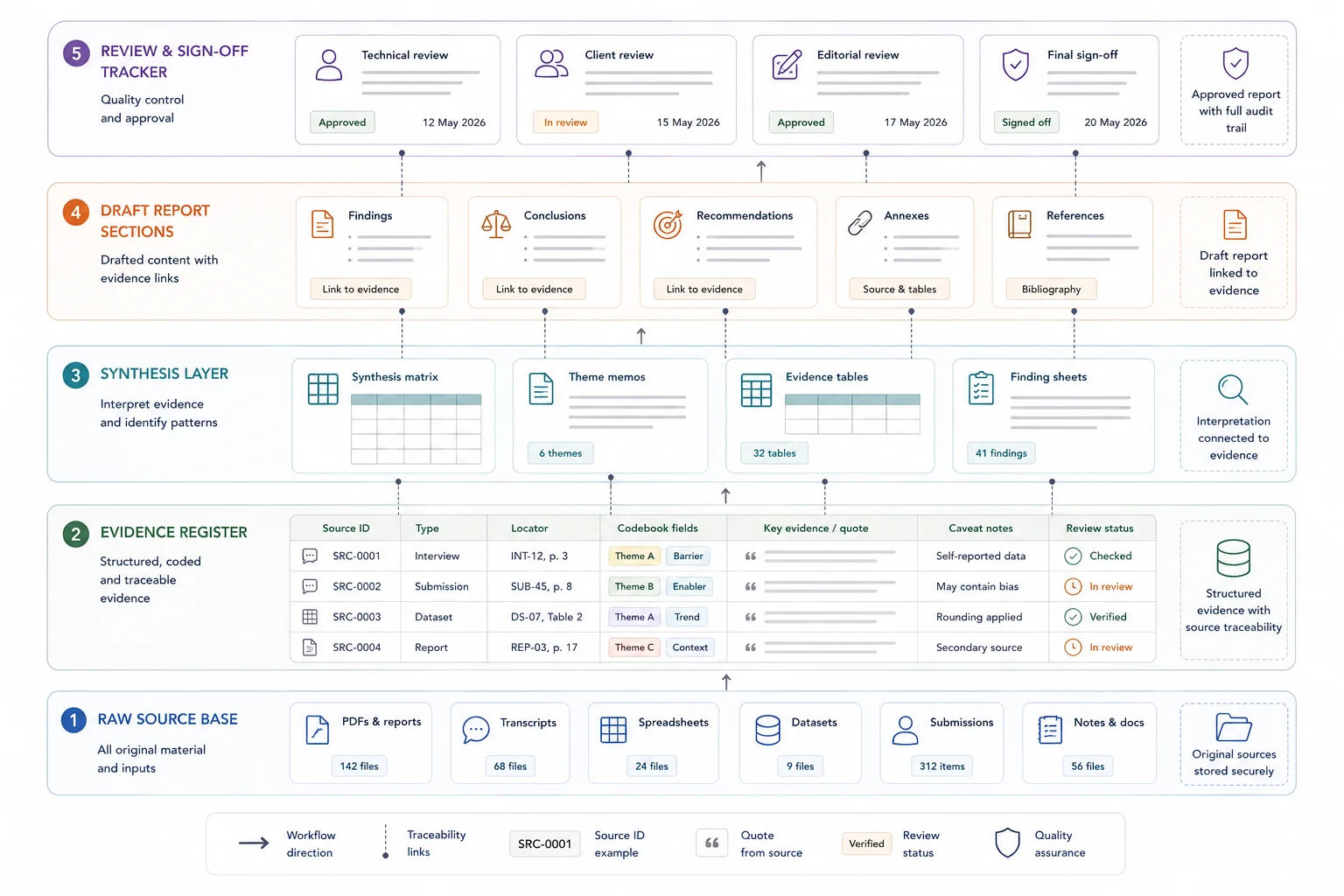
A simple layer model often works best:
- raw source base
- evidence register or extracted record layer
- synthesis layer such as matrices, evidence tables, or theme memos
- draft report sections
- review comments and final revisions
This reduces drift. Writers can work from prepared evidence rather than from scattered folders, and reviewers can move back down the chain when they need to verify something.
Use a synthesis structure that makes writing easier
The middle of the workflow is where raw material becomes usable. Good synthesis does not flatten the evidence. It condenses it without breaking the route back to source.
Choose the middle layer to match the job
Not every report needs the same synthesis structure. Some teams need evidence tables by question. Some need theme memos. Some need a framework matrix for cross-case comparison. Some need finding sheets that map evidence, caveats, and draft wording to one section of the report.
The Framework Method is a strong fit when the team needs to compare many qualitative inputs across themes, groups, or geographies and still preserve source traceability. If you need the full step-by-step method, How to Synthesise Stakeholder Submissions with the Framework Method goes deeper into catalogues, codebooks, pilot coding, matrixing, and QA.
Chart for retrieval, comparison, and caveat control
The synthesis layer is not there to look tidy. It is there to make writing and review easier.
A useful matrix cell or evidence table entry carries more than a summary. It keeps enough context to answer questions such as:
- which source or subgroup this point came from
- whether the point was widespread, mixed, or exceptional
- which caveat or limitation matters
- which quote, excerpt, or record can verify the summary
- which report section or question the point is likely to feed
This is also where analytic memos matter. They explain why a theme was merged, why a caveat stayed visible, or why two response channels should not be read as if they mean the same thing.
Mini example: from matrix cell to draft finding
A useful matrix entry keeps the summary, the source, and the caveat together so the writer is not reconstructing the logic later.
| Report question | Cell summary | Source locators | Caveat | Draft finding |
|---|---|---|---|---|
| What is blocking follow-up care? | Transport costs and referral confusion recur across district interviews and two workshops. | INT-014 p.3; INT-021 p.5; WS-02 item 7 | Urban respondents reported shorter referral delays. | Follow-up barriers are not only about service capacity. Access and navigation problems are shaping drop-off. |
Treat findings as supported patterns, not as polished verdicts
The synthesis layer should produce candidate findings before it produces polished conclusions.
A finding says what the evidence shows. It can describe a recurring pattern, a subgroup difference, a constraint, a contradiction, an outlier worth keeping visible, or a gap that limits interpretation. It should still stay close to the material.
That discipline matters in live delivery work. The Local Government White Paper workflow used synthesis outputs that could feed drafting across themes without pretending every issue meant the same thing. The UNICEF Palestine case did the same by linking coded issues, service-access records, and recommendation inputs before final narrative judgement was applied.
Write the report so the logic stays visible
By the time drafting starts, the hardest work should already be done. The writer still has a serious job to do, but it should be a writing and judgement job rather than a frantic search-and-rebuild job.
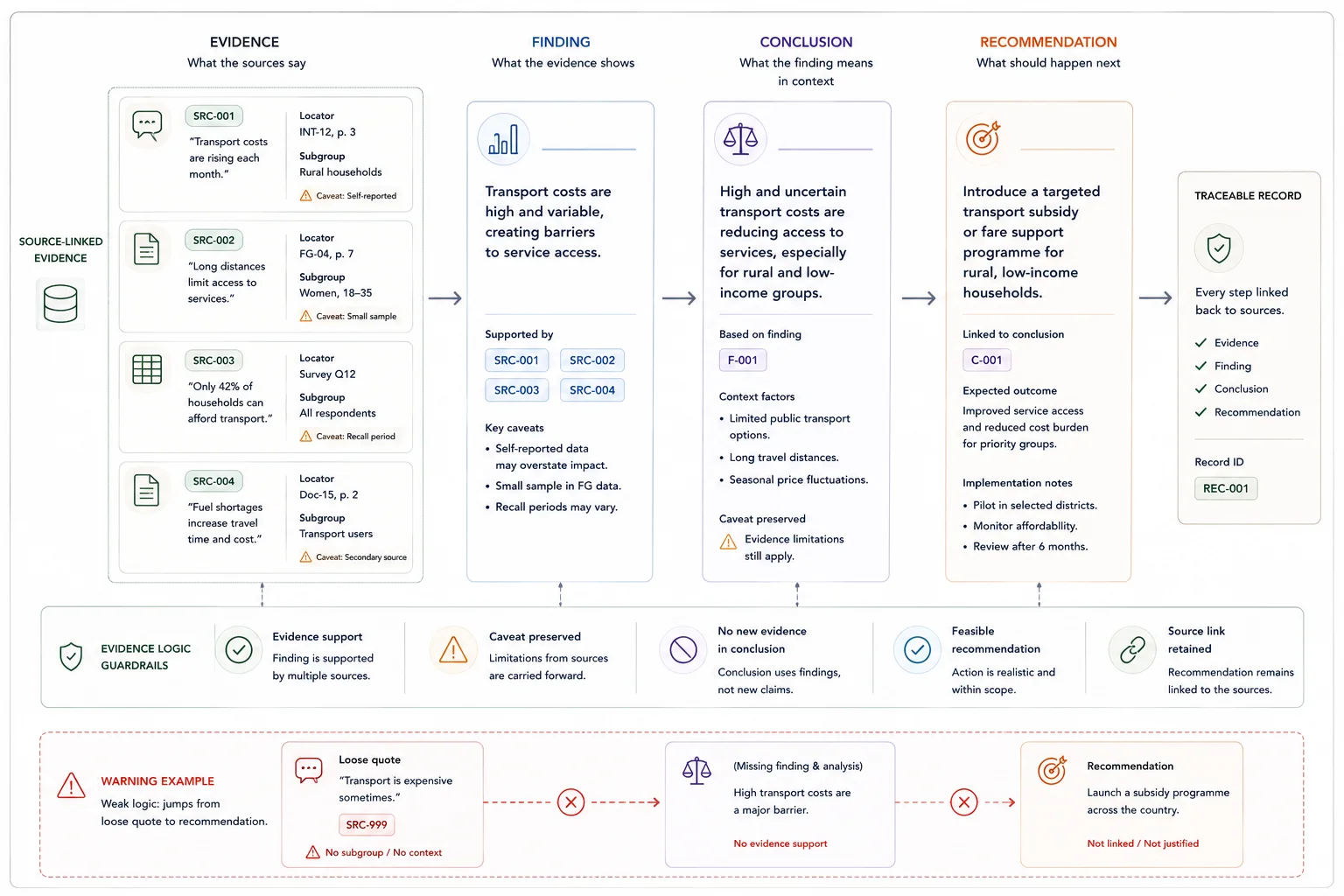
The key distinction to protect is simple: findings say what the evidence shows, conclusions say what that pattern means in context, and recommendations say what should be done next. Once those layers blur, review gets harder and overclaiming becomes more likely.
Lead with context, purpose, and method
The strongest reporting standards line up on structure. The CDC's evaluation reporting guide says reports should be shaped around the target audience and desired action, with clear summaries and appendices for readers who need more depth. UNICEF's adapted UNEG report standards say context, purpose, and methodology should normally come before findings.
That order helps the reader see what question the report is trying to answer, how the material was handled, and what limits matter before interpretation begins.
Keep findings, conclusions, and recommendations distinct
This is where many reports start to blur.
A clean distinction helps:
- findings describe what the evidence shows
- conclusions explain what those findings mean in relation to the purpose or question
- recommendations propose what should happen next
Those layers should connect, but they are not interchangeable. Conclusions should be substantiated by the findings and should not introduce new evidence. Recommendations should be logically derived from the findings and conclusions, point back to the evidence, and stay realistic about context, constraints, and audience.
This is the move that turns a report from a document that simply restates information into one that supports action without overreaching.
Use appendices to keep depth without clogging the narrative
Not every reader needs the same level of detail.
Main sections should carry the narrative, the most decision-useful findings, the core interpretation, and the recommendation logic. Appendices can carry evidence tables, extraction templates, codebooks, extended methods, additional subgroup tables, or source documentation that would otherwise slow the main reading flow.
NICE's evidence-review manual is especially helpful here because it keeps extracted evidence in standard templates and evidence tables, while the main document carries the synthesised narrative that the committee or audience actually needs. That same split helps commercial and public-sector reports too. The main body stays readable, while the supporting material remains available for review.
Add AI where it helps and keep human review in charge
AI can speed parts of the workflow, but it does not remove the need for evidence design, method clarity, or accountable interpretation.
Use AI on top of structure, not instead of it
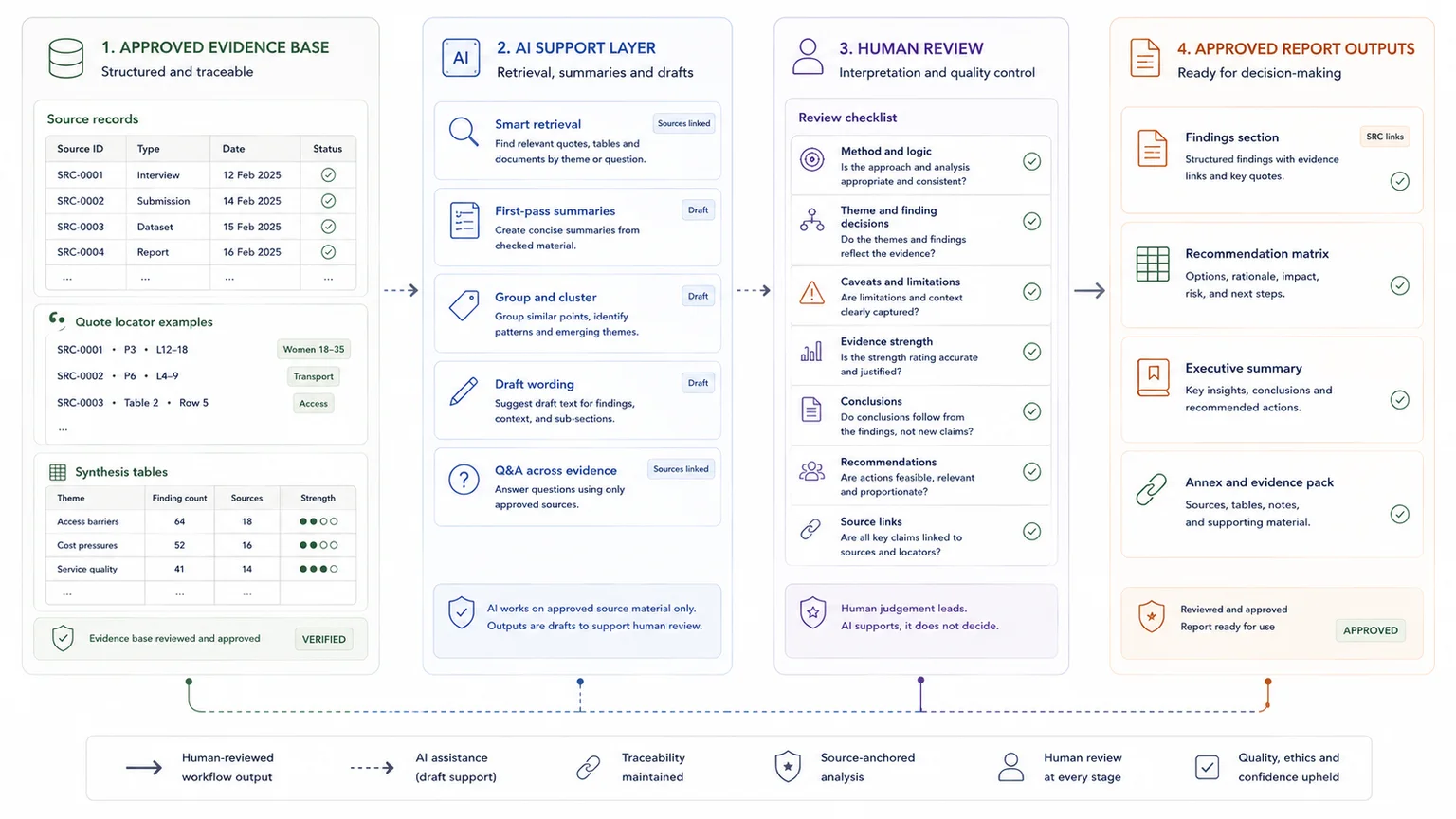
AI is most useful after the evidence base has IDs, clear fields, and a working synthesis structure. At that point it can help with retrieval, first-pass grouping, summarising, question answering across a curated corpus, or drafting support from already checked material.
If the structure underneath is weak, AI usually makes the confusion faster. That is why AI-ready knowledge environments and report-writing workflows belong in the same conversation.
Keep human judgement on theme decisions, caveats, and recommendations
Human review should stay in charge of:
- setting the method and codebook logic
- deciding what stays separate and what gets grouped together
- judging whether a pattern is strong enough to report
- interpreting conflicting or thin evidence
- writing conclusions in proportion to the evidence
- making recommendations that are feasible, ethical, and context-aware
The UK Department for Transport's AI Consultation Analysis Tool evaluation is useful here because it combines automation with auditable stages and human review after automated theme extraction. That is the right pattern for sensitive reporting work.
Design the workflow so auditability survives the AI layer
If AI is used anywhere in the chain, keep the same audit trail discipline.
Record where the input material came from, what structured fields or source sets were in scope, which human reviewer checked the result, and how the approved output fed the draft. When a recommendation or conclusion matters, the team should still be able to move back to the evidence that supports it.
That is also where the site's case studies matter as proof rather than theory. In the UNICEF Zambia workflow, AI speed gains were only useful because quote-per-claim guardrails, validation, and human review were already in place. In the UNICEF Palestine workflow, AI-assisted retrieval supported a compressed delivery window because the evidence base, recommendation inputs, and draft structure were kept connected.
Related guides
These adjacent guides are useful when this workflow needs a tighter next step: source-linked evidence table, findings-to-recommendations matrix, decision-ready insight. Also see source traceability, messy evidence workflow.
When a simple setup is enough
- The report is short and has one author
- There are few sources and limited review points
- The audience only needs a concise internal update
When you need a more structured system
- The report has many sections, contributors, sources, or review rounds
- Claims and recommendations need to be checked against evidence
- The final output may be shared with clients, funders, boards, or public bodies
Common mistakes to avoid
Treating drafting as the first step
Drafting works better when the evidence, section logic, and review pathway are clear first. Otherwise the draft becomes the place where every problem appears.
Using comments as the review system
Document comments are useful, but they should not be the only review tracker for evidence questions, ownership, and sign-off.
Checking sources after the writing is finished
Source checks should happen as claims are drafted. Late checks often lead to avoidable rewrites.
Report logic checklist
Use this before drafting or reviewing a report
| Check | Done |
|---|---|
| The report has a clear decision or audience need | |
| Each section has a distinct purpose | |
| Claims are linked to evidence | |
| Findings are separated from recommendations | |
| Review points are tracked in one place | |
| The final version can be checked against source material |
Related resources
Use these next if you need to move from the article into a related workflow, calculator, case study, or service.
- Data Use, Reporting & Communication Systems - use this if you need help turning evidence into a clear report
- Evidence Insight Reporting Engine - use this if reporting needs a structured evidence workflow
- Traceable Evidence Workflow Support - use this if the source material needs synthesis before drafting
- Reporting Bottleneck Cost Calculator - use this to estimate the cost of slow review and drafting
- How to stop losing source traceability - use this if claims are hard to check
- Turn interviews and case studies into report-ready findings - use this if qualitative material feeds the report
FAQ
What is a report-writing workflow?
A report-writing workflow is the full chain from evidence scoping and source handling through synthesis, drafting, review, and recommendation development. It is not only the drafting stage.
What belongs in the middle layer between evidence and the final report?
Usually matrices, evidence tables, coded summaries, memo notes, finding sheets, or comparison tabs. The point is to give writers something structured, source-linked, and reviewable to draft from.
What is the difference between a finding, a conclusion, and a recommendation?
Findings state what the evidence shows. Conclusions interpret what those findings mean. Recommendations say what should happen next.
Should evidence tables go in the main report or in appendices?
Use the main body for the narrative and the decision-useful summary. Put detailed evidence tables, extraction templates, or expanded methods in appendices when they support review but would slow the main reading flow.
What should a report-ready evidence table contain?
At minimum, keep the report question or theme, a concise summary, the source or subgroup, a source locator, any important caveat, and a note on how the point is likely to feed drafting.
Can AI write the report for us?
AI can support retrieval, first-pass summarising, and drafting from checked material, but human reviewers should still own the method, interpretation, and final recommendations.
What is the difference between a reporting workflow and a report development process?
A report development process usually describes the stages of producing the report. A reporting workflow is more practical. It shows how source material, analysis, drafting, review comments, version control and sign-off move through the team.
What are workflow reports?
Workflow reports are outputs that show the status, progress, delays or results of a process. In evidence-heavy work, the more useful question is often the reverse: what workflow is needed to produce a reliable report?
Build the workflow that lets reporting hold up
A report holds up when the reader can follow the logic from evidence to interpretation to action without guessing what happened in between.
That requires more than good writing. It requires a prepared evidence layer, a synthesis structure that preserves caveats, and a drafting process that keeps findings, conclusions, and recommendations in proportion to the material underneath them.
Sources used in this guide
These are the main external references behind the workflow described above.
Used for early evidence planning, indicators, and data collection strategy.
Read sourceUsed for the defined analytical cycle and method discipline.
Read sourceUsed for explicit, systematic, and transparent evidence review.
Read sourceUsed for the framework matrix, charting, and memoing logic.
Read sourceUsed for source IDs, tracking logs, codebooks, and audit trails.
Read sourceUsed for audience, desired action, summaries, and appendix logic.
Read sourceUsed for report structure and the distinction between findings, conclusions, and recommendations.
Read sourceUsed for the three-phase consultation analysis example.
Read sourceUsed for auditability and human review after automated theme extraction.
Read sourceData Use, Reporting & Communication Systems
Use structured data in reports, dashboards, internal tools, public microsites, applications, presentations, annual reports, and decision-support workflows.